Übermensch in a Cubicle Farm Pt 5: "The Reckoning"
AI isn't disrupting product management as a category. It's disrupting the execution layer of it specifically. If you've been telling yourself you're on the strategic side of that line, this post is about whether that's true.

Four posts into this series, we've covered a lot of structural ground: the industrial-era construction of the white-collar professional identity, the Valley mythology that turbocharged it, the compensation architecture that made it material, and the decade when the mythology quietly decoupled from the work but kept insisting otherwise. Today we land on the question the series has been building toward: what happens now, and what does it mean specifically for product management?
The honest answer is more complicated than either the optimistic or the pessimistic version. Let me try to give you the structural one.
What AI Is Actually Disrupting
Precision matters here, because the discourse has been both overwrought and underspecified.
Generative AI is not replacing software engineers or product managers as categories. It is compressing the time and headcount required to execute discrete, well-specified, bounded units of work – the kind of work that Post 4 described as the feature factory tier. The frontier tier, where the problem space is genuinely novel and human judgment is the scarce resource, is being augmented. The feature factory tier is being structurally disrupted.
For product management, this cuts along a specific seam. The PM functions most exposed to AI are the execution-heavy, documentation-intensive, ticket-generating layer: writing specs for well-understood features, synthesizing structured user feedback at scale, maintaining roadmap documentation, generating status communication. These are real skills. They are also, increasingly, tasks that AI handles adequately.
The PM functions least exposed are the ones that were always, if we're honest, the hardest to teach and the hardest to hire for: judgment about genuine market uncertainty, alignment across competing organizational interests in ambiguous situations, product strategy in domains where the right question hasn't been identified yet. These functions require the kind of contextual, relational, and organizational intelligence that AI augments rather than replaces.
This bifurcation within the PM role mirrors the bifurcation within the industry that Post 4 described. And it creates a clear strategic implication: the mythology that treated all PM work as unified -- that said the ticket-writing PM and the market-sensing PM were doing the same essential thing -- is no longer analytically useful, if it ever was. The work is separating, and where you sit in that separation matters for how you think about your positioning.
The Pillars Have Shifted
The structural mechanisms that Post 3 described – RSU vesting cages, stack ranking tournaments, founder aspiration – were calibrated for a specific era and a specific tier of the industry. They are all degraded now, and the degradation is most pronounced for the feature factory tier that AI is simultaneously targeting.
The equity retention mechanism loses its psychological force when layoffs have demonstrated that the implicit contract can be withdrawn mid-vest. The performance tournament produces increasingly absurd results in a workforce that has been reduced multiple times. The founder aspiration, as a mass psychology rather than an individual path, requires more active suspension of disbelief than most practitioners are currently extending to it.
None of this means those mechanisms have disappeared. They haven't. But for the feature factory PM cohort, the three structures that made individual optimization feel like the only rational strategy are all operating at reduced capacity simultaneously. That's a new situation.
What the Models Look Like
This series has been careful not to overstate the organizing question, and the finale is not the place to start. But it's worth being clear-eyed about what exists.
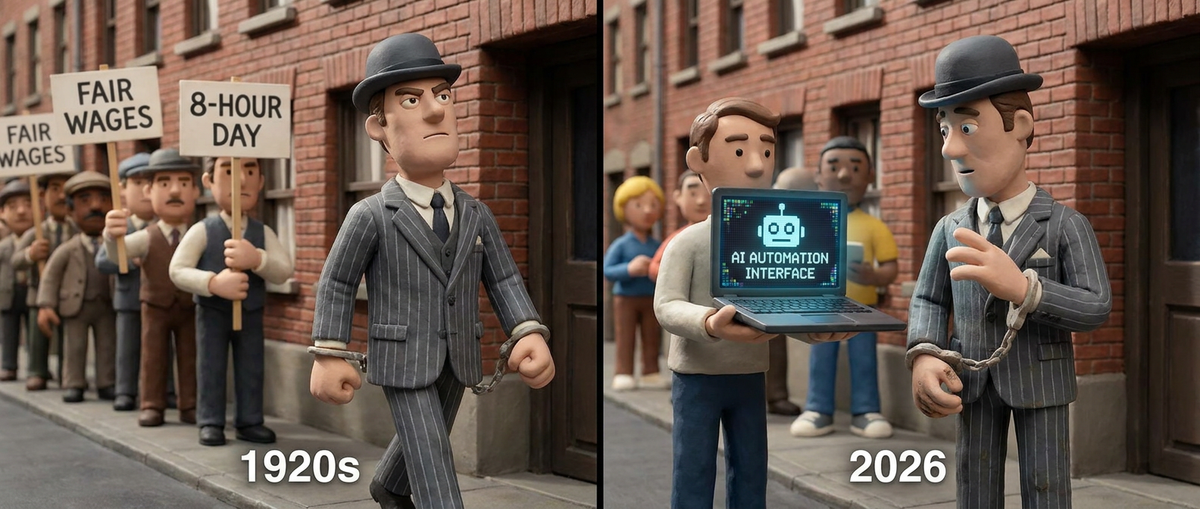
The SAG-AFTRA 2023 agreement is the most instructive precedent for knowledge workers in creative and technical fields. It established, for the first time in a major labor agreement, that workers have a specific claim on how AI uses their labor – consent requirements, compensation frameworks, jurisdiction over synthetic work product. The principle is more important than the specific terms. It demonstrates that AI provisions are negotiable, that the terms are not simply dictated by technology or by capital, and that a formal bargaining structure is what makes that negotiation possible.
Game workers organizing through the CWA offer a closer analogy to the PM context -- creative, technical, project-based work in an industry built on a passion-work mythology. The wins have been incremental and hard-fought. They are real.
For product management specifically, the professional association infrastructure -- PDMA, Mind the Product, the PM community broadly -- is a network without a labor function. It has never been designed to protect practitioners' economic interests collectively, and it shows. The gap between what a mature professional community does for its members and what the PM community currently does is a structural observation, not a criticism of the organizations involved.
Whether that gap gets filled is genuinely uncertain, and depends on choices that practitioners haven't collectively made yet.
What This Means Practically
Let me close this series with something more concrete than a structural argument, because the Bistro audience tends to find that more useful, and fairly so.
The mythology is cracking. The bifurcation between frontier and feature factory work is becoming visible whether the industry names it or not. AI is accelerating that visibility. The compensation structures that made individual optimization feel mandatory are operating under stress. The implicit contract has been openly violated enough times that faith in it requires effort.
In that environment, the most durable positioning for a PM is probably not the one the mythology sold. The founder-aspiration story, the visionary-PM narrative, the idea that your equity makes you an owner rather than an employee with deferred compensation -- these framings are not serving most practitioners well in 2026, and the evidence for that has been accumulating for several years.
What is worth investing in is the work that AI doesn't compress: the judgment capacity that comes from genuine domain depth, the organizational intelligence that comes from actually understanding the humans in the room, the strategic thinking that requires holding genuine uncertainty rather than processing specified requirements.
That's not a union card. It's not a structural solution to a structural problem. But it's honest, and the mythology was not, and at this particular moment in the industry's history, honesty about where you actually stand seems like a reasonable place to start.
"Ubermensch in a Cubicle Farm" is a five-part series. Start from the beginning with Part 1: "The Collar Color Was Never Quite What It Seemed."