Übermensch in a Cubicle Farm Post 4: The Ticket Queue Is Not a Career
Part 4: The promise bifurcated, and many were sold a bill of goods. For most, the grind of the feature factory was lived experience

We've been building a structural argument across this series. Post 3 showed how RSU compensation and stack ranking worked together to create a workforce that was simultaneously financially dependent on its employer and structurally competitive with its peers – conditions that made collective responses to shared problems nearly impossible. Today we look at what happened when that system met an industry that had quietly outgrown the conditions it was designed for.
For product managers, this post is probably the most personally recognizable entry in the series. The dynamics it describes are not abstract history. Most of us lived them.
The Expansion and the Split
CS enrollment at American universities roughly doubled between 2010 and 2020, producing a large cohort of graduates who entered a tech job market that appeared, at the time, to have unlimited appetite. The appetite was real. What it was absorbing, for a significant and underexamined portion of those graduates, was something the mythology hadn't prepared them for.
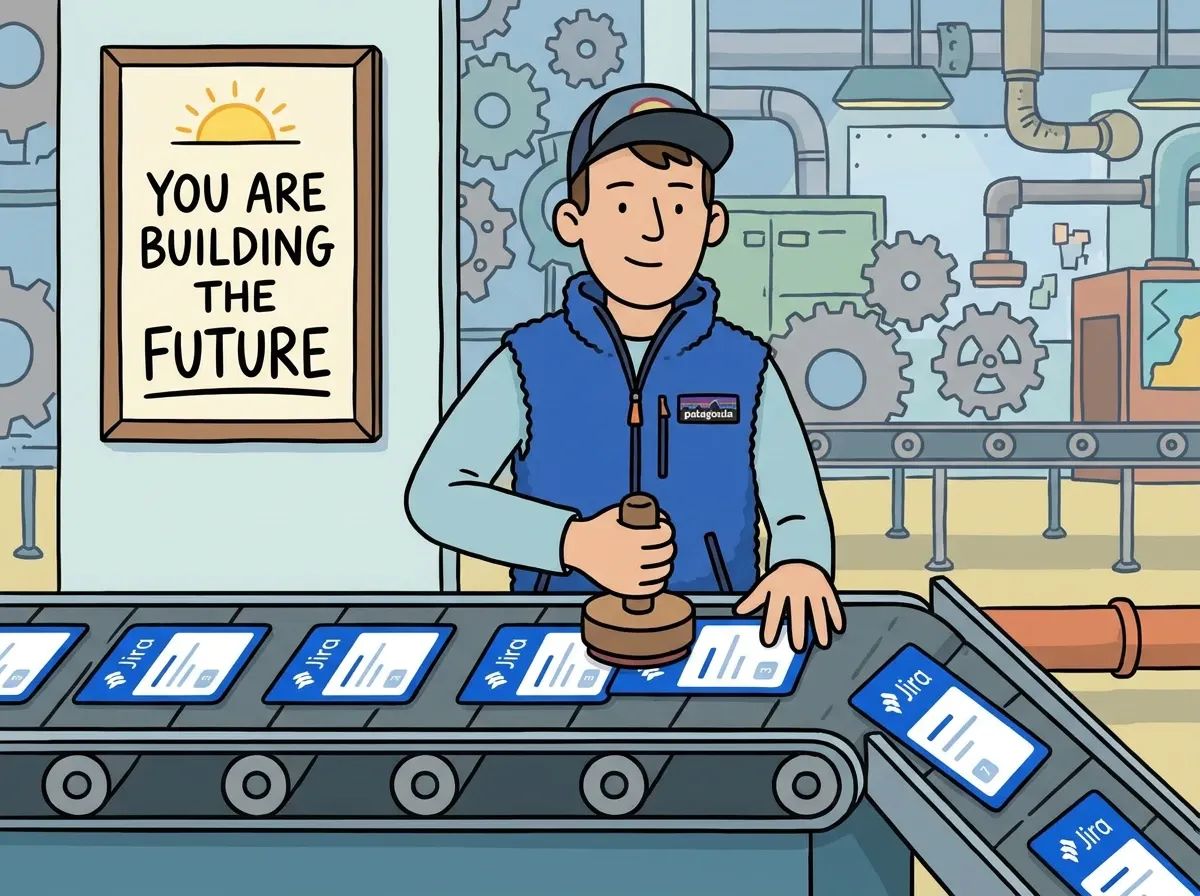
The 2010s were the decade of SaaS, which is a genuinely useful business model and also, for much of its workforce, a fundamentally different kind of work than the founding mythology described. Building multi-tenant enterprise software for mid-market verticals requires real engineering skill. It is not, in any meaningful sense, operating at the frontier of human possibility. It is feature development against a roadmap, executed inside a well-understood technical architecture, in service of business objectives that have nothing to do with the transformative narrative that recruited most of these workers into the field.
For product management, this distinction is particularly important to name. The PM role in a genuine frontier context -- early-stage product, novel technical architecture, genuine market uncertainty -- looks meaningfully different from PM in a mature SaaS company. Both are real product management. The skills overlap substantially. But the mythology treated them as identical, which meant that a generation of PMs built their professional identity around a narrative of frontier work while doing, in practice, something considerably more operational.
Nobody named this split clearly, because doing so would have required the industry to acknowledge a hierarchy of work that the "we're all in this together" mythology actively obscured.
The Bifurcation in Practice
What actually emerged in 2010s tech was a two-tier structure the industry's self-presentation didn't acknowledge.
The first tier: genuine frontier work. AI research, core infrastructure, early-stage product development at companies creating new categories. Technically demanding, high-ceiling compensation, and legitimately close to the mythology. The PM role at this tier was genuinely strategic in the full sense of the word.
The second tier: the feature factory. Enterprise SaaS, internal tooling, incremental product development at companies whose primary business was emphatically not technology. Competent, well-compensated work that the mythology conflated with frontier work despite having a fundamentally different risk and reward profile. The PM role at this tier was frequently execution-heavy, stakeholder-management-intensive, and roadmap-driven in ways that left limited room for the "visionary product leader" identity the conference circuit sold relentlessly.
The compensation structures from Post 3 applied across both tiers. The implicit contract -- perform well, demonstrate loyalty, and the system will take care of you -- applied across both tiers. The mythology applied across both tiers. The actual outcomes, when the system was stressed, did not.
The 2018 Walkout and Its Lesson
Before the stress test arrived, there was a signal worth examining.
On November 1, 2018, approximately 20,000 Google employees walked off the job globally (gift link) in protest of how the company had handled executive misconduct – specifically, the revelation that Andy Rubin had received a $90 million exit package after credible misconduct findings. The walkout was organized in days and constituted the largest collective action in tech industry history.
Google made procedural concessions. The organizers were subsequently sidelined through the patient application of bureaucratic pressure – reassignments, diminished scope, the gradual erosion of influence that doesn't require a single explicitly retaliatory act.
The structural lesson for practitioners is precise: collective action was demonstrably possible in tech. Sustaining it without a formal bargaining structure was not. There was no mechanism to hold Google to its commitments, no legal framework that mapped cleanly onto a spontaneous walkout at a non-union employer, and no institutional channel for the energy to run through once the immediate moment passed.
The Alphabet Workers Union, which formed in January 2021 as a direct descendant of those organizers, reflects that lesson. Its structure as a minority union -- open to all workers including contractors, but without a formal bargaining unit -- is a pragmatic response to the organizing terrain. It can advocate and publicize. It cannot compel negotiation. The gap between those two capabilities is where most of the structural story lives.
The Implicit Contract and Its Withdrawal
The 2022-2023 tech layoff cycle -- over 200,000 positions across an industry that was, in most cases, profitable at the time -- is discussed most often as a financial story about interest rates and margin compression. It is also a story about a contract being withdrawn without renegotiation.
The people laid off in that cycle had, in most cases, been operating inside the mythology in good faith. They had accepted the constraints of the vesting schedule, tolerated the performance tournament, subordinated their individual leverage to the implicit promise that loyalty and performance would be rewarded with stability. Many had been explicitly told, recently, that their contributions were valued and their positions were secure.
The badge deactivation on a Thursday morning was not a renegotiation of that contract. It was a unilateral termination of it, dressed in the language of "restructuring" and "right-sizing" in ways that asked the affected workers to understand the business rationale while the business offered no equivalent consideration.
For product management specifically, the layoff cycle had a secondary effect worth naming. PMs were disproportionately affected in several of the larger reductions, reflecting a broader question about role definition that the feature factory context had always contained: if the work is primarily execution and stakeholder management, how much of it requires a dedicated PM function versus being absorbed into engineering or business operations? That question was already present in the mythology gap. The layoffs made it a live business decision.
What Generative AI Is Actually Disrupting
Generative AI is frequently described as a threat to software engineering in aggregate. The more precise description is that it is a significant amplifier for frontier-tier work and a genuine displacement threat for feature factory-tier work. The distinction matters because the mythology insisted there was no meaningful difference between them.
For product management, the AI question is sharper than it's often framed. The aspects of the PM role that are most exposed to AI augmentation or displacement are precisely the execution-heavy, documentation-intensive, ticket-generating functions that dominated feature factory PM. The aspects that are least exposed -- judgment about genuine market uncertainty, alignment across competing organizational interests, product strategy in novel domains -- are, not coincidentally, the aspects that the frontier-tier mythology always claimed the whole profession was about.
The feature factory didn't become vulnerable to AI suddenly. It became visible. And the PM roles that were defined primarily by the operational layer of feature factory work are now in an environment that is asking, with genuine seriousness, whether that layer needs a dedicated professional function at all.
That's the question the final post in this series tries to answer. Or at least, to ask more precisely.
Next: "The Reckoning" – AI displacement, the cracked implicit contract, and whether fifty years of structural anti-solidarity conditions have finally shifted enough to change the outcome.