Ubermensch in a Cubicle Farm pt. 1: The Collar Color Was Never Quite What It Seemed
Tech in general is very resistant to organizing. As we enter the AI age, it seems like this missed opportunity will haunt the industry. A look at how this began (a series)

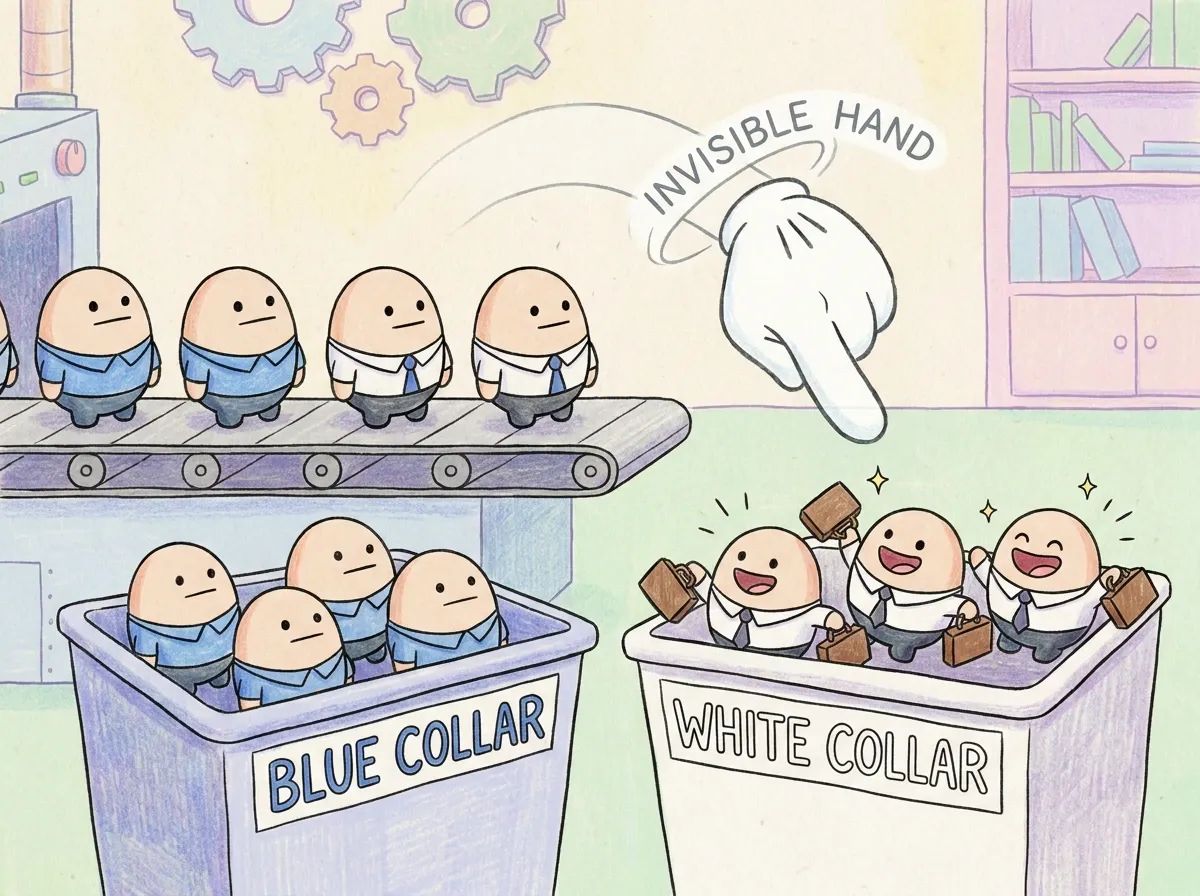
Time for a "back to the future" series, this time on the labor movement, and why the general "Tech" ecosystem said "nah bro" over it.
It is the fall of 1919. The steel industry is on strike. Nearly 365,000 workers have walked off the job in what will become one of the most significant labor actions in American history, and it is going to lose badly. Not just because U.S. Steel has the money and the lawyers and the Pinkertons. It loses, in part, because a whole category of worker who probably should have been on the picket line decided instead to cross it.
The clerks. The bookkeepers. The supervisors. The men in better suits with slightly cleaner hands. They went in. Not because management held a gun to them. Because they genuinely believed they were on the other side.
That belief didn't come from nowhere. It was built, deliberately and systematically, over the preceding fifty years. And it is the same belief, wearing a Patagonia vest and carrying an Allbirds bag, that walked into open-plan offices across Silicon Valley for the next century without ever once questioning which team it was actually playing for.
This is the first in a series about how that happened, how tech didn't invent the con but perfected it, and why 2026 might be the year the whole architecture finally starts to crack.
The Factory Is for Other People
The word "professional" is doing a lot of work in American cultural life, and most of it is ideological cover. When you hear someone describe themselves as a "professional," what they're usually signaling is that they are not, in any meaningful sense, labor. They have a career, not a job. They are evaluated on outcomes, not hours. They wear what they want (mostly). They eat lunch when they feel like it.
These distinctions feel natural. They are not. Every one of them was deliberately constructed to recruit a segment of the workforce into identifying upward – toward capital – rather than sideways, toward the people who actually depended on their wages to survive.
The material mechanisms were almost comically straightforward once you see them. Salary instead of wage meant you stopped thinking of your compensation in hourly terms, which meant you stopped thinking of your time as something you were selling. A separate entrance, a separate cafeteria, a desk near the owner's office rather than a spot on the floor – these weren't perks. They were invidious distinctions, a phrase borrowed from Thorstein Veblen, who wrote about this kind of status signaling in 1899 and remains, more than a century later, annoyingly correct about all of it.
The white-collar worker's deepest terror wasn't poverty. It was reclassification. Being sent back down. Being made to punch a clock. That fear, more than any paycheck, is what held the identity together.
The Credential Racket
The other thing that happened in this period was the formalization of the "profession" as a concept, and this is where the con gets genuinely elegant.
The Flexner Report in 1910 transformed American medicine from a messy, inconsistently trained, frequently dangerous trade into something approaching a genuine discipline with rigorous standards. That part was legitimately good. What came with it, though, was a guild structure that linked credential to status in a way that made the professional identity feel earned rather than constructed. You weren't just a doctor. You were a Doctor. The credential didn't just certify competence – it conferred belonging to a class.
Law did the same thing. So did accounting. And these weren't neutral developments. They were, among other things, mechanisms that limited labor supply, maintained fee structures, and built a collective professional identity strong enough that organizing against capital became psychologically incoherent. You don't join a union when you consider yourself management's intellectual peer.
C. Wright Mills documented all of this in White Collar in 1951, a book that is probably more relevant today than when it was published and that almost nobody in tech has read. His argument, stripped to its bones: the new middle class had been recruited into the cultural project of capitalism without being given any meaningful ownership stake in it. They did the ideological work of the ownership class for free, because they'd been convinced that they were, in some sense, that class.
Who Built This and Why
It didn't just happen organically. The Sloan-era managerial revolution at General Motors in the 1920s is the textbook case of how you deliberately cultivate a white-collar stratum that does ownership's bidding without being asked. Alfred Sloan's genius wasn't the organizational chart,
it was understanding that if you gave managers enough status signals, enough separation from the shop floor, enough of a sense that their interests aligned with the company rather than with workers, you got an enormously effective class of people who would actively resist labor organizing on your behalf. For free. Because they thought it was the right thing to do.
This is not a conspiracy theory. Nobody needed to sit in a dark room and plan it. It emerged from incentive gradients that were obvious to anyone paying attention, and it was reinforced by every decision about titles, compensation structure, physical office layout, and cafeteria access. The architecture built itself because it worked.
Here's the part that should stick with you: this was all in place, and had been for decades, before anyone wrote a single line of code. Silicon Valley didn't invent the professional identity that makes workers allergic to solidarity. It inherited it, and then fed it a bunch of steroids.
Why This Matters Right Now
The story of why tech workers don't organize – and largely still don't, even as the industry is actively replacing a substantial portion of its workforce with AI – is usually told as a culture story. The ping pong tables and the free lunches and the "we're a family" horseshit. And sure, that's part of it.
But the culture story is downstream of something structural. The ideological scaffolding that makes tech workers resistant to collective action was not invented in Palo Alto in 1995. It was built in Pittsburgh and Detroit and New York starting in the 1870s, refined over a century of trial and error by people who understood exactly what they were doing, and then handed to the tech industry like a loaded weapon that nobody had to explain how to fire.
The next four posts are going to walk through how that weapon got upgraded, who pulled the trigger, and what it means that it's now pointed at the people who thought they were safe.
Because the collar color was always a con. They just made it really comfortable.
Next: "The Valley Mythology Machine" – how Silicon Valley synthesized fifty years of white-collar ideology, libertarian philosophy, and founder mythology into something its predecessors could never have imagined.