The Role That Hollowed Itself Out: A Eulogy for Product Management
The title survived. The ceremonies survived. The Jira boards are still getting groomed. What didn't survive: the function that made product management worth having in the first place. A diagnosis.

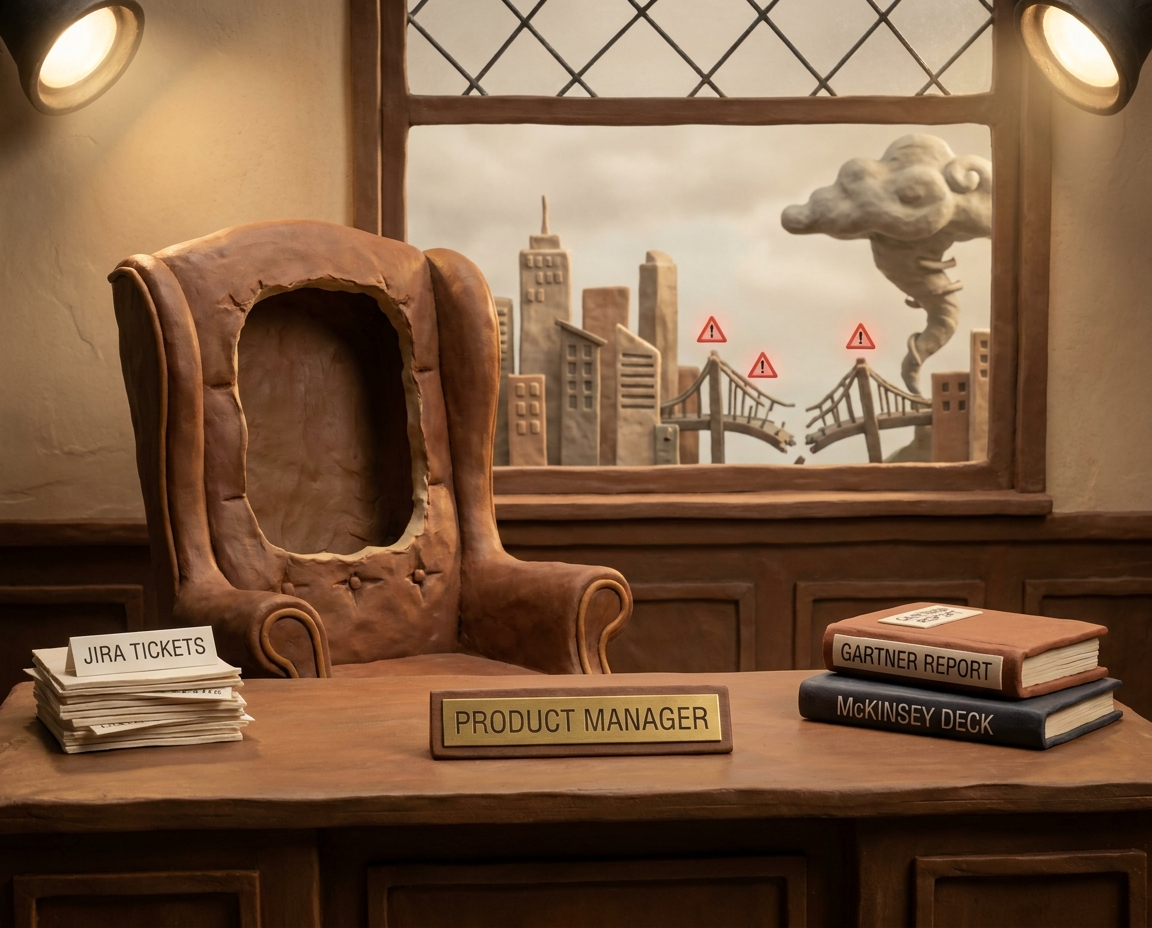
This is a long post, but something I have been musing on lately as I watched the field of Product Management degrade into something unrecognizable. I am very sad, and wrote 3,000 words on it...
Somewhere in the last twenty years, product management was quietly disassembled and replaced with something that wears its clothes. The title survived. The job description survived, more or less. The LinkedIn profiles are still there. What didn't survive is the function — the actual work that made the role worth having in the first place.
This isn't a recovery narrative. The conditions that would make recovery possible don't exist in most organizations, and the industry has moved on without noticing what it lost. This is a diagnosis, and an honest one: what the role was, how it got hollowed out, what filled the void, and where the function lives now — if it lives anywhere at all.
What Product Management Was Actually Supposed to Be
The origin story matters here. Product management as a professional discipline didn't come from Silicon Valley. It came from Procter & Gamble in the 1930s, where Neil McElroy's famous memo proposed a new organizational model: one person responsible for a brand as if it were a business. That person would own the market understanding, the competitive positioning, the customer relationship, and the financial performance of their product. No direct reports, total accountability. A general manager in miniature.
That model migrated into technology as the industry matured, and it carried the same basic shape. The PM was the person who held the market thesis — who could walk into a room and say "here is what our customers actually need, here is why our competitors are wrong about it, and here is the strategic bet we should make." Not as a PowerPoint exercise, but as a distillation of sustained engagement with customers, competitors, and market dynamics.
The authority shape was unusual: accountable for outcomes, responsible for direction, dependent on engineering teams you didn't manage and sales teams that occasionally ignored you. Surviving in that position required genuine analytical credibility, the ability to build influence without authority, and — crucially — the courage to surface inconvenient findings in rooms that didn't want to hear them.
That last attribute matters more than it gets credit for. The good PM wasn't just the smartest analyst in the room. They were the person willing to say "the thing we believe about our customer might be wrong, and here is the early signal that suggests we have six months before that becomes expensive." That is not a comfortable function to perform. It doesn't make you friends. But done well, it prevents the class of product failure that no post-mortem ever correctly diagnoses — the one where everyone was working hard from the wrong map.
And critically: it was a career. The path from PM to VP and then to General Manager of a business unit was real and well-worn enough to attract people with genuine general management ambition — people who were thinking about P&L, competitive positioning, and organizational authority, who saw product management as a proving ground rather than a destination.
That career is largely gone. And with it went most of the conditions that made the function possible.
The Deskilling: Three Vectors, Not One
The hollowing-out happened simultaneously from three directions, which is part of why nobody stopped it.
The Agile capture is the most structurally underappreciated. When Ken Schwaber and Jeff Sutherland formalized Scrum, they embedded a product role inside the framework: the Product Owner, explicitly conceived as a customer-facing backlog manager. This was a role designed by engineers for engineering process control. The Product Owner exists to answer questions and keep the queue full, not to develop market theses or hold strategic vision. The role definition preceded the talent response to it — organizations adopted the framework, adopted the role definition, and then wondered why their product managers had stopped thinking strategically. The answer was that the framework had defined strategy out of the job description before anyone fully noticed.
The artifact proliferation ran in parallel. Jira, Confluence, Productboard, and their many cousins converted PM identity into tool operation. When your days are organized around backlog grooming, sprint planning, and velocity tracking — when your primary artifacts are tickets and acceptance criteria and release notes — the role becomes defined by what you produce rather than what you understand. The PM who runs the ceremonies rather than owns the market is a different role wearing the same title, and the distinction is invisible to most of the organization. Which is part of what made the substitution so clean.
The founder mythology is the third vector, and arguably the most culturally powerful. The Jobs-Bezos-Zuckerberg archetype says the best product management comes from founder-engineers who have direct product vision without mediation. Once that mythology takes hold, professional PM is implicitly reframed as an unnecessary layer between the people with real instincts and the people doing actual work.
The problem is that the mythology is mostly misread, in engineering's favor. Steve Jobs was not an engineer. He was a taste-maker and anthropologist who understood what people would feel about a product before they'd ever touched it — which is, if anything, the ur-case for the PM value proposition, not an argument against it. Jeff Bezos has an engineering degree but built his pre-Amazon career entirely in finance; his operating genius was a quant's mind applied to customer obsession, working backwards from customer needs with the rigor of a D.E. Shaw analyst. Zuckerberg is the only actual engineer of the canonical three, and his product judgment record on human impact is not the advertisement you'd want.
Engineering culture appropriated the founder-as-PM story to justify displacing professional product ownership from a set of examples that don't actually support the argument. The mythology took hold anyway, because it was useful.
The Status Inversion Nobody Talks About
Between 2010 and 2020, engineering compensation and organizational status were elevated dramatically — hiring wars, scarcity premiums, the ten-times-engineer mythology, engineers appearing on cap tables. Product management didn't receive equivalent treatment. The status differential shifted, and with it the implicit authority relationship.
When engineering is the premium function, PM gradually becomes the person who feeds the machine rather than directs it. The roadmap becomes a negotiated document rather than a strategic commitment. The sprint backlog becomes the de facto product strategy. The PM who once held the market thesis as organizational property now presents it to engineering for approval.
This produced an adverse selection spiral that is probably the most underappreciated mechanism in the whole story. As the role's career trajectory became less viable and its organizational status declined, the people with genuine general management ambition read the trajectory and left. They went to Chief of Staff roles, which absorbed the cross-functional-influence-without-direct-authority function. They went to Strategy and Operations titles, which preserved analytical credibility without the Agile-ceremony overhead. They went founder, or operator-turned-investor, or into the small number of organizations that maintained the original model under different labels.
What remained in the PM function skewed toward people more comfortable in a coordination and process role — which further confirmed engineering's read that PM is essentially project management with strategic pretensions. Which made the role less attractive to the next cohort with genuine strategic instincts. The spiral is self-reinforcing and, at this point, mostly complete.
The False Floors
As genuine market intelligence left the building, two substitutes moved in. Neither works. Both persist because they share one property that genuine customer insight doesn't: they produce defensible artifacts.
Sales as customer proxy is corrupted at the source in ways that are predictable and systematic. Sales engages customers in a specific transactional context where the customer is also performing — managing the relationship, avoiding candor that might affect pricing or delivery, framing requests in terms of things they believe they can actually get. The signal reaches product through two layers of motivated reasoning. You never hear from churned customers, non-buyers, or the adjacent-use-case person who solved the problem a completely different way. The VOC report looks like customer intelligence. It is actually a map of what your existing customers will say to your salespeople in a sales context. Those are not the same thing.
The credentialed consulting engagement is a more sophisticated version of the same problem. A McKinsey or Gartner engagement typically isn't being purchased to discover truth. It's being purchased to convert a management preference into an external finding. The CEO or CPO has already decided on a direction — an acquisition, a strategic pivot, a restructuring — and what they need is an authority-branded artifact that transforms "this is what I want to do" into "this is what the objective analysis recommends."
The structure of the engagement guarantees the outcome. The scoping conversation embeds the hypothesis. The staffing model — credentialed analysts executing frameworks handed down from partners — is optimized for rigorous-looking synthesis of available information, not for the pattern recognition that comes from years of domain immersion. Partner incentives run on relationship continuity; consistently delivering bad news loses clients. And accountability never attaches to the recommendation: when a McKinsey-endorsed strategy fails, the post-mortem attributes it to execution or market conditions, not to the analysis.
The failure record that goes unattributed is long. McKinsey had an extended consulting relationship with Enron and praised their innovative business model. Swissair's aggressive acquisition strategy that ended in 2001 bankruptcy was a McKinsey recommendation. The firm's work with opioid manufacturers eventually generated nearly $600 million in legal settlements. Gartner's Magic Quadrant, meanwhile, is structurally a lagging indicator — it measures the competitive landscape among established vendors and systematically misses the disruptive entrant arriving from an adjacent space. It missed the significance of cloud disruption in enterprise software for years. The vendors that eventually dominated often didn't appear on the quadrant until they were already winning.
The $250,000 engagement isn't buying insight. It's buying absolution. And organizations keep buying it because the alternative — investing in the conditions that develop genuine market intelligence — produces no equivalent artifact, no credentialed citation, and nothing that distributes blame if the bet goes wrong.
The Amazon Caveat, Briefly
Amazon's PR/FAQ and Working Backwards process deserves mention as the most serious counterargument. The methodology genuinely does force customer-backward reasoning before engineering resources are committed. The single-threaded ownership model genuinely does prevent the diffusion of accountability that kills product thinking in matrix organizations. These are real structural contributions to how product ownership should work.
But Amazon is not a clean counterexample. Its PM culture runs as a high-pressure tournament — a filtration system that retains whoever matches a specific psychological profile and discards everyone else. The survivors look like evidence of talent development; the casualties are simply off the books. It is less a product management model than a ruthless self-selection mechanism that occasionally surfaces exceptional people while burning through everyone else.
And then generative AI completes the circle. The PR/FAQ's actual value wasn't the document — it was Bezos's theory that the writing discipline would expose weak reasoning that a slide deck could hide behind transitions and bullet points. GenAI can produce a plausible PR/FAQ in twenty minutes that would have taken a thoughtful PM two days. It produces the form without forcing the thinking. The document that looks right and the document that is right become indistinguishable, especially to a busy reviewer who is pattern-matching rather than interrogating assumptions. Even Amazon's most rigorous model is now vulnerable to the same hollowing-out that took the rest of the profession.
What the Function Actually Was
Here is the short version of what genuine product management does (or did) that nothing else replicates.
A PM in possession of sustained customer exposure and accumulated market pattern recognition becomes the organizational mechanism for surfacing inconvenient signals before they become expensive surprises. Not signals that confirm the direction. The other signals — the ones where a customer says something that doesn't fit the narrative, where a competitor's move doesn't make sense until you understand the market they're actually targeting, where the data has a small anomaly that everyone is ignoring because the thesis is already committed.
That is a challenge function, and it is inherently uncomfortable. It requires the analytical confidence to trust your read of the signal over the room's consensus. It requires the organizational courage to say the thing nobody wants to hear in a room full of people who have staked credibility on not hearing it. It doesn't make you friends. The best outcome available in most organizations is grudging respect — the minimum acknowledgment paid when someone prevents something expensive enough that the alternative is too embarrassing to contemplate.
The fiasco you didn't have is invisible. The fiasco you had is visible, expensive, and attributable. So the PM who prevented three disasters through early signal detection gets grudging respect, and the organization continues to underinvest in the conditions that made the prevention possible, because the counterfactual never shows up on a balance sheet.
That function didn't die when the role hollowed out. It disaggregated. It lives in founder-CEOs who did the customer work themselves and never stopped. It lives in Chiefs of Staff who absorbed the cross-functional challenge role. It lives in the occasional Head of Strategy who actually does primary research rather than commissioning it. These people mostly stopped calling themselves Product Managers a decade ago.
The Last Refuge Is Gone
For a long time, small companies were the oasis where the original model survived. The founder was close enough to the customer that they valued insight over analyst-laundered authority. The organization was too small for process bureaucracy to take hold. The PM's market judgment was directly legible to leadership because leadership had done that work themselves. The career stakes of a bad product bet were existential enough that nobody wanted the comfortable wrong answer — they wanted the uncomfortable right one.
That oasis is gone now. The YC and venture ecosystem standardized startup operating models around Agile before most small companies developed their own instincts — the hollowed-out model arrived as received wisdom before anyone thought to question whether it was right. The founder-as-PM mythology is even more powerful at small scale, where the founder often does hold the product vision and the PM role becomes definitionally subordinate — a translation layer between founder instinct and engineering execution, rather than an independent market intelligence function. The talent pool has been corrupted over time: the PMs available to hire were trained in the hollowed-out model at larger organizations, and often don't know what they don't know. And GenAI makes it easy for a founder to conclude they don't need a PM at all for artifact production — which is not entirely wrong, given what the role had become, but is not a substitute for the function that actually mattered.
The closure of the small company exception is probably the most diagnostic signal in the whole story. It means the original model is no longer being reproduced anywhere in the ecosystem in a form that trains the next generation of people who know how to perform it. The people who carry the genuine instinct are aging out. The conditions that developed the instinct don't exist in enough places to replace them. Even if an organization decided tomorrow that it wanted genuine product ownership, finding someone who can actually deliver it is harder than it has ever been.
What Doesn't Come Back
The title with that career trajectory is not coming back. The organizational role with that authority shape is not coming back. The professional category that attracted people with genuine general management ambition is not coming back. The forces that dismantled it — Agile capture, status inversion, founder mythology, GenAI commoditization of the artifacts — are not reversing.
What hasn't disappeared is the function. Organizations that understand the difference are building something more resilient than the title ever was — housing the challenge function in roles with the authority and conditions to actually perform it. The function lives somewhere in every organization that ships products. Sometimes it's well-housed. More often it's fragmented across people who perform pieces of it without anyone owning the whole, or it's simply absent, replaced by the defensible substitutes that confirm existing direction while the inconvenient signals go unsurfaced.
The organizations still running Agile ceremonies with someone called a Product Owner are running an expensive simulation of product management without the thing that made it valuable. The Product Owner who grooms the backlog is not a substitute for the person who holds the market thesis, reads the weak signals, and is willing to say "we might be wrong about this" with enough credibility and organizational standing that it actually changes a decision rather than just producing a dissent for the record.
The honest question for any organization isn't how to rehabilitate the Product Manager title. It's whether they understand that the function still needs to live somewhere — and whether they're being honest with themselves about where they've put it, who has the standing to perform it, and whether those people have the sustained customer exposure and accumulated market pattern recognition to do the work.
Most organizations, if they answer honestly, will find that the function is not particularly well-housed. The McKinsey deck is not housing it. The sales VOC report is not housing it. The AI-generated PR/FAQ is definitely not housing it.
Something real has to own the market thesis. Something real has to surface the inconvenient signal before it becomes an expensive surprise. Something real has to be willing to say "we might be wrong about this" in a room that doesn't want to hear it.
That's what product management was supposed to be. Whether it lives in someone with that title is, at this point, almost beside the point.
Coda
This is something that has been brewing in my mind for a long time. I have watched this degradation of the role with the rise of Agile (and I like the Agile processes) and the commodification of the role.
As I am 3 decades into my Product Management journey, I see the end of my journey over the next few years. I try to impart my discipline on my juniors, and they eagerly absorb it, but that is a drop in the Pacific Ocean.
What say you? Do you have similar thoughts? Or am I full of crap and it's a golden age of Product Management?
The comments are open, or send me an email at geoff@prodbistro.com