The Fiberglass Plant and the Photomask Writer
Everyone's calling the AI buildout 'industrial.' A fiberglass plant and a photomask shop are both industrial — and only one of them can fund itself.

Early in my career, I spent time supporting an instrument that measured line widths on photomasks — the templates that get a circuit pattern onto a silicon wafer — for a company called DuPont Photomasks. One of their plant managers, in Santa Clara, California, vented to me one day about a fight he kept losing with the people back at headquarters in Wilmington. Every three years or so, his operation needed several million dollars to replace the writers and metrology tools that made and checked those masks. And every three years, Wilmington wanted to know why. Because down the road, there was a fiberglass plant that had been running on the same equipment for forty years and just kept printing revenue, year after year, without anyone in finance asking uncomfortable questions about it.
His complaint, boiled down, was: why does my division have to keep re-justifying its existence to people sitting next to a business that hasn't had to think about capex since at least the Nixon administration? He wasn't wrong to be annoyed. He also, as it turns out, wasn't wrong about what kind of business he was in.
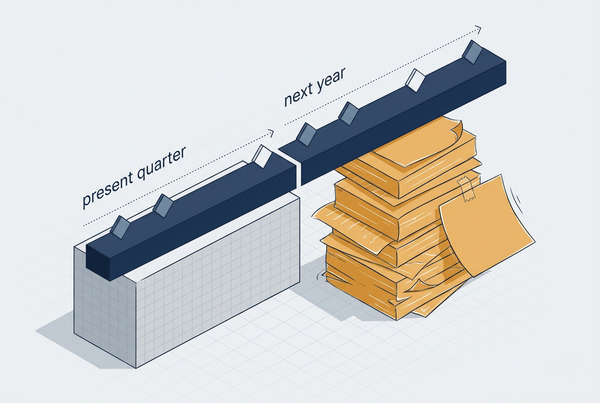
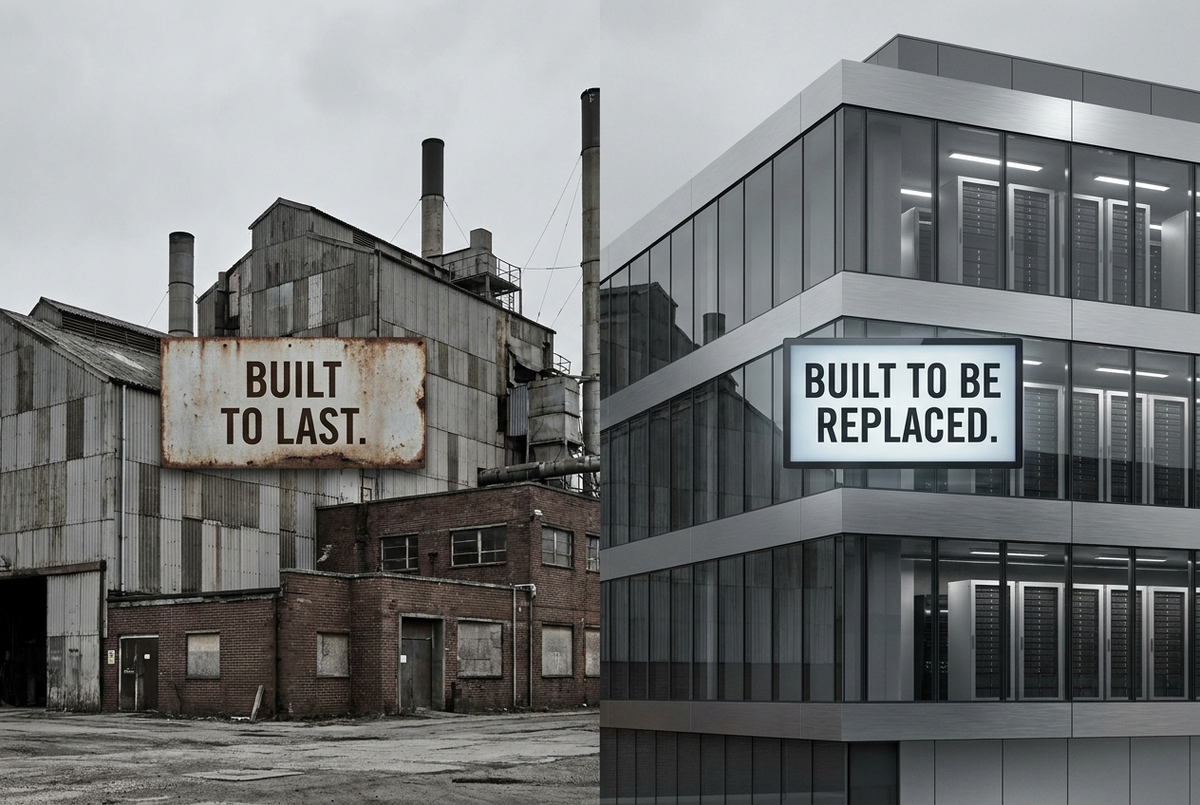
I keep returning to that conversation as I watch the AI buildout get described, over and over, as tech "going industrial." Hundreds of billions of dollars a year, real concrete, real turbines, real transformers — yes, fine, it's industrial. But "industrial" is doing an enormous amount of unexamined work in that sentence, because a fiberglass plant and a photomask shop are both industrial, and they are not remotely the same business. One of them is an asset that, once built, just sits there generating cash for decades. The other is a treadmill — an asset whose entire value proposition depends on your ability to keep replacing it faster than your competitors replace theirs. Confusing the two is exactly the mistake the people in Wilmington were making thirty years ago.
And the AI buildout isn't the fiberglass plant. It's the photomask shop, except worse, because of a detail that didn't really exist in the photomask era: this time the building itself – the shell – is on the treadmill too. Nvidia is shipping new architectures every 18 to 24 months, against depreciation schedules that hyperscalers have set at five to six years — that gap alone is the photomask problem, restated. But on top of that, the physical data center has stopped being the stable part of the equation. Legacy rack density used to sit somewhere around 2 to 8 kilowatts. Current AI training racks are running past 120 kilowatts, and the industry is openly projecting a path toward 600. A building designed for 2022-era density isn't just running older chips — it may be the wrong building, full stop. In the photomask world, at least the fab itself was the fiberglass plant. Here, both halves of the asset are now consumables.
If you want proof that even the people running these companies haven't settled this, look at what Amazon and Meta did in the same quarter, looking at the same Nvidia hardware, in the same macroeconomic environment. Amazon shortened the useful life of a chunk of its servers from six years to five, explicitly citing the pace of change in AI and machine learning, and ate a $700 million hit to operating income for the privilege of being conservative. Meta, in that same quarter, extended its server useful lives to 5.5 years and booked a $2.9 billion reduction in depreciation expense — close to 4% of its pretax profit for the year. Two of the most sophisticated finance organizations on the planet stared at the same pile of GPUs and came back with opposite answers about how fast it's dying. That's not a rounding error in an actuarial assumption. That's the Wilmington argument, playing out in 10-K footnotes, at a scale where the difference between "five years" and "six years" is worth billions of dollars a quarter.
None of this is because the people running these companies are naive about the physical world — quite the opposite. Satya Nadella has talked openly about having warehouses full of GPUs with nowhere to plug them in because there's no power. Zuckerberg has casually noted that a gigawatt of data center capacity is roughly the size of a nuclear power plant, and that nobody's built one yet. These guys are fluent in the hardware. What they haven't updated is the risk culture that comes with it. Tech learned, correctly, that in software the cost of being wrong is low — you ship something, it flops, you write it off, you move on to the next thing. "Move fast and break things" was never really a statement of values. It was a statement about software's unusually forgiving cost structure. Nobody rewrote that instinct for a world where the things that get broken are buildings.
The DuPont Photomasks story, it turns out, didn't end where I assumed it had. Toppan bought the company in 2005. But the treadmill never actually stopped needing outside money — it just kept changing which door it knocked on. In 2022, Toppan carved the photomask business back out as a joint venture with a private equity firm. Two years later it got rebranded, and late last year it went public again, raising roughly a billion dollars. Thirty years, four ownership structures, and the business still can't fund its own replacement cycle without going back to capital markets. The AI industry is proposing to run that exact same play — outside capital feeding a short-life asset — except instead of IPOs, the door they're knocking on is special-purpose vehicles, and instead of a billion dollars, it's tens of billions per deal. Same treadmill. Much, much bigger room.