Who Killed the Product Manager?
(or: how we quietly dismantled the one role that understood the whole business)


Let me ask you something. When was the last time your product manager came back from a customer visit with something that genuinely surprised the organization? Not a survey result. Not a NPS score. An actual human insight that nobody inside the building had thought to ask about.
If you're struggling to answer that, this post is for you. And if you're a GM or a VP reading this thinking "we have processes for customer feedback," I'd gently suggest that's exactly the problem.
Something happened to product management over the past fifteen years or so, and it happened so gradually that most organizations didn't notice until the damage was done. The role didn't get eliminated. It got quietly hollowed out and restuffed with something that looks similar on an org chart but does fundamentally different work.
Here's how it happened.
In the late 2000's, Agile swept through the industry like a religious conversion. I was an early believer. At a company making enterprise communications software, I stood in front of a kanban board covered in hand-written 3x5 cards, running three-week sprints, doing full-day demos followed by retros followed by happy hour at the local pub - which I funded, because that's what you did when you were trying to build something real. It felt like the right way to work. Collaborative, transparent, honest about what was getting done and what wasn't.
But I noticed something early. The daily standup meant I needed to be present, physically, in front of that board. Which meant I couldn't travel. Which meant getting next to actual customers was becoming, for the first time in my career, genuinely inconvenient. It was a small thing at first. An inconvenience. The kind you rationalize because everything else about the process feels so good.
That inconvenience, compounded over years and layers of organizational evolution, eventually became a dungeon.
The methodology evolved. SAFe arrived, promising to scale Agile to large organizations. And look, I've heard all the SAFe jokes, and most of them are earned. What SAFe delivered in many shops - mine included - was more ceremony, more documentation, more PI planning events, and somehow less connection to the market. The backlog got bigger. The meetings got longer. The customer got further away.
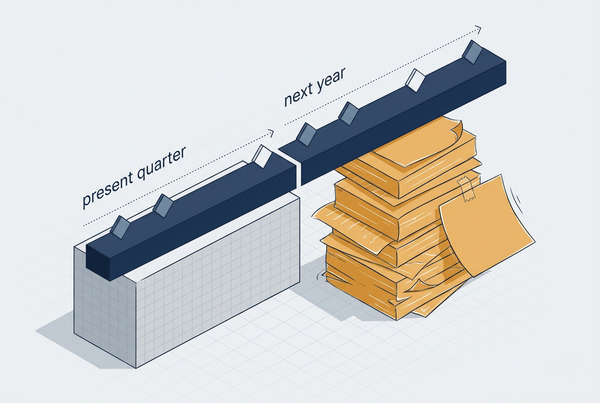
Meanwhile, the tools got better. Jira, Confluence, Figma, Productboard - genuinely impressive software that creates structure and clarity for development teams. Useful things. The problem is that they also create gravity. Engineering needs feeding. Sprints need stories. Backlogs need grooming. And the product manager is right there, proximate and available, increasingly defined by their ability to service that machine. The path of least resistance is to become the best backlog curator in the building.
At the same time, conferencing software got good enough that travel became hard to justify on a spreadsheet. Zoom, Teams, WebEx - why spend $15,000 sending someone to Seoul when you can get them on a call? It's a reasonable question if you're only counting the cost of the trip. It's a catastrophically bad question if you understand what you lose when the product manager stops leaving the building.
And the conference circuit - MRS, Semicon, the big industry gatherings where you'd spend three days talking to dozens of people across the ecosystem and walk away with a genuine feel for where the energy was - those events started losing their pull too. Organizationally defunded. Personally deprioritized. A rounding error in a travel budget review.
Each of these, taken alone, looks like a reasonable business decision. Together, they landlocked the product manager.
I want to tell you about a trip I took in 2006.
We made large format interferometric profilers - precision measurement equipment for semiconductor packaging. Specifically, we measured solder balls on flip-chip substrates. In the early 2000's, orders had dried up almost completely. A competing technology had taken our market, and the assumption inside the building was that the industry had moved on. We were essentially on life support in that segment.
Then we started hearing rumors about a new, larger substrate format coming - 400x600mm. Big enough that the old assumptions might not hold. So we did something that seems almost quaint now: we got on planes.
Four countries. Eight customers. Two and a half weeks. Me, a director of marketing, and one engineer whose management had to be practically arm-wrestled into letting him leave for that long. Total spend somewhere around $60,000.
What we learned: the technology that had displaced us was fast, but it couldn't measure the smaller solder balls that current CPU designs were demanding. The customers who had sent us packing a few years earlier were quietly running into a wall. There was a market, and it was becoming critical, and nobody inside our building had known because nobody had gone to ask.
That trip generated a solid $4 million a year run-rate in the original segment, plus opened doors in adjacent precision measurement markets we hadn't seriously considered before.
Just by talking to people.
One of those customer meetings, in Japan, was conducted in the smoking shed out back. That's where they put us. That's how much they thought of us as a vendor at that point. Two years later they were a reliable customer.
Oh, and when we flew from Japan to Taiwan, my passport had less than six months of validity left. Taiwan wouldn't let me in without paying a $200 "visa" fee on the spot. Full Homer Simpson moment. I paid it and got on with it, because turning around wasn't an option. The trip was too important.
That $200 might be the best investment I ever made on behalf of an employer.
Here's what I want the GMs and VPs reading this to sit with for a moment.
The product manager, when the role is functioning properly, is the connective tissue of your business. Not the deepest expert in any single domain, but conversant enough across all of them to hold a coherent picture that nobody else has. The GM has the P&L but not the pulse. Engineering has the product but not the market. Sales has the pipeline but not the pattern. A good product manager has the synthesis.
When I was hiring for the role, I looked for people who had been in customer-facing positions - field service engineers, senior support people, applications engineers who'd spent years sitting across from frustrated customers proposing solutions. People who had earned real customer scar tissue. Those roles exist today, but somewhere along the way, product management stopped looking like a step up to the people in them. So the pipeline shifted. More candidates coming up from inside the building, from engineering, from data and analytics. Smart people, often very good at the internal language of the organization. Not always equipped for the external one.
The result is an organization where the inbound function - the market-facing, customer-synthesizing intelligence that product management used to provide - is nobody's explicit job. Sometimes it gets stapled onto the data and analytics team, who have all the dashboards in the world and struggle to pull the threads that tell you why something is happening, let alone what to do about it. Sometimes it gets outsourced to industry analysts, whose custom research has a funny habit of confirming whatever the VP already believed. Either way, the building is flying a bit blind and calling it insight.
Nobody made a decision to dismantle this. That's the insidious part. They made a hundred small decisions - adopt this methodology, cut this travel budget, lean on these tools, hire from this background - and the cumulative effect was to quietly unplug the nervous system.
The product manager is still on the org chart. They're just not doing the same job anymore.
And if you're wondering why your product decisions keep feeling slightly off, why the market keeps surprising you, why your roadmap always seems to be solving for the problem you had eighteen months ago rather than the one your customers have now - that might be worth examining.
The answer probably isn't another tool.
Have a take on this? Drop it in the comments.
 Share on Bluesky
 Share on Threads
 Share on Facebook
 Share on Mastodon
 Share on Reddit
 Share on LinkedIn
 Share on Email