The Deskilling Machine: How We Hollowed Out Product Management — and What AI Is About to Do to Everything Else
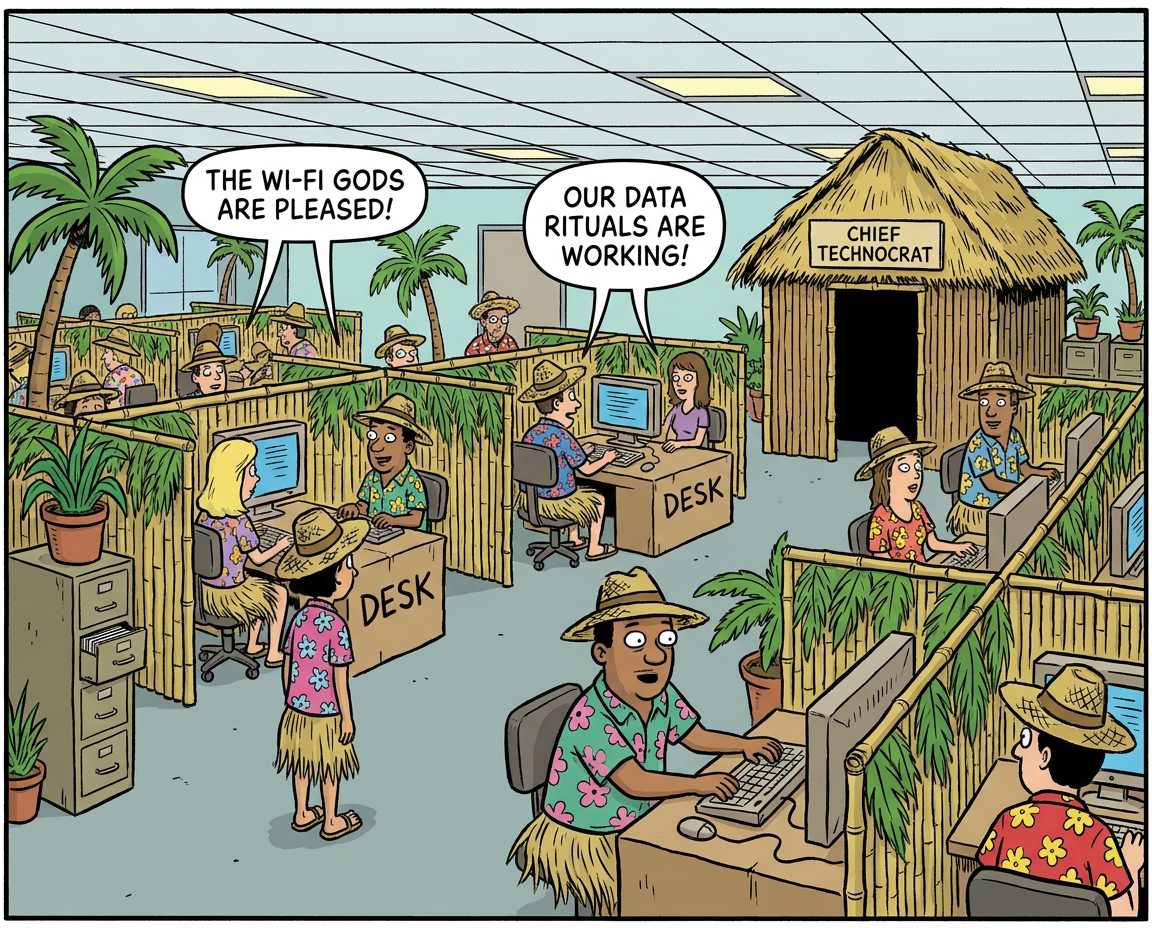
Or, this is the removal of the Cargo Cult technocrats, hired to work, but not to have a purpose. You surely have come across these drones.

There's a narrative floating around about the tech layoffs. You've probably heard it. The AI is so powerful, so transformative, that companies simply need fewer people. Lean into the future. Move fast. Trust the model.
It's a tidy story. It also conveniently obscures the far more uncomfortable truth: a significant portion of the roles being eliminated shouldn't have existed in the first place — not because the work wasn't real, but because the work had been engineered into irrelevance over the better part of a decade. The AI didn't hollow these roles out. We did that ourselves, methodically, with great enthusiasm, using tools that were supposed to make us better at our jobs.
I've watched this happen to product management up close. And I'm watching the exact same mechanism spin up again, this time with a trillion-dollar tailwind and executives who are actively cheering it on.
Note: this was inspired by a podcast where Eli the Computer Guy (Youtuber) was on and he described the tech majors as awash with employees hired during the pandemic without a true need, or even a job. Warm bodies, and his term for this was that these souls were akin to a Technocrat Cargo Cult.
The Classical PM Is a Ghost
There's a version of product management that used to be the standard, or at least the aspiration. The PM as the person who understood the customer more deeply than anyone on the engineering team, who understood the market well enough to spot the gap, and who understood the technical constraints well enough to make the bet. The authority on what gets built and why, with real accountability attached to whether it worked.
This was never a ceremonial role. It was adversarial in the right ways — pushing back on engineering timelines, pushing back on sales commitments, pushing back on executive pet projects. The best PMs I've encountered early in my career had opinions backed by evidence and were willing to defend them in rooms where they were outnumbered. They were occasionally wrong. They owned it when they were.
That PM is largely a ghost now. What replaced them is something different in kind, not just degree.
How Agile Ate the Role
The first mutation happened when Agile swept through the industry. The framework is fine, in principle. What it did to the PM role in practice was something else.
The Scrum framework codified the "Product Owner" as a defined function within the sprint cycle — the person responsible for the backlog, for acceptance criteria, for the daily back-and-forth with developers about what done looks like. This is real work. It's also a fundamentally different job than being the authority on product strategy.
When organizations adopted Agile at scale, many of them mapped "Product Manager" to "Product Owner" without examining what that trade-off actually cost them. The PM went from being someone who operated above the development process — making directional calls, validating with customers, navigating market reality — to someone embedded within it, processing tickets and maintaining a prioritized queue. The locus of power shifted. The engineering team's velocity became the primary metric. The PM became, essentially, a well-paid interface between the business stakeholders and the sprint board.
The title stayed the same. The accountability for outcomes quietly evaporated.
The Tools Finished the Job
Then came the tools. And this is where it gets genuinely insidious.
Jira for backlog management. Aha! or Productboard for roadmapping. Miro for discovery and ideation. Amplitude for product analytics. UserTesting for research. Confluence for documentation. Figma for design handoff workflows.
Each of these tools is built around a discrete workflow. Each workflow implicitly defines a set of tasks. Complete the tasks, and by the tool's own logic, you've done your job. The roadmap is in Productboard. The backlog is groomed in Jira. The research artifacts are in Miro. Everything is visible, everything is tracked, everything looks like product management.
Here's what the tooling actually accomplished: it made it possible to perform every ritual of the PM role without developing the underlying judgment that makes those rituals meaningful. You can become a proficient Jira administrator and a genuinely terrible product manager simultaneously, and in many organizations nobody has the visibility — or the incentive — to notice the difference.
This is the cargo cult in its purest form. The anthropological original involved Melanesian islanders building wooden airstrips and carved headphone sets after World War II, attempting to summon cargo planes through ritual imitation of what they'd observed. "The form is perfect. It looks exactly the way it looked before. But it doesn't work."
A well-maintained Jira board is a perfect set of wooden headphones. The planes aren't coming.
The pandemic-era hiring explosion didn't create this problem. It just hired a hundred thousand people into an already-mutated role, handed them SaaS subscriptions, and called them product managers. When the money ran out and organizations looked around to figure out what everyone was producing, a lot of those headcounts couldn't answer the question cleanly. Because the tools had never required them to.
Here We Go Again
I'd be tempted to treat this as a cautionary retrospective — a lesson learned, a course corrected — except that we are running the identical playbook right now with generative AI, at larger scale, with more money, and with executive enthusiasm that should terrify anyone paying attention.
The pitch is this: you don't need experienced practitioners anymore. Junior people, augmented by AI, can produce senior-level output. You get the productivity without the salary. The AI fills the gap.
This is not an emerging hypothesis. It is explicit corporate strategy. Executives are saying it out loud. Some are proud of it.
What they are describing — and I want to be precise here, because precision matters — is deliberately replacing the pipeline that produces expertise with a tool they believe can simulate expertise (and make no mistake, it is simulating expertise, it is guessing). That is not innovation. That is a catastrophic accounting error dressed up in the language of disruption.
The Pipeline Is Not a Faucet
Expertise is not a static resource. It doesn't sit in a tank that you can draw down and then refill when you need more. It is a living system that requires continuous renewal — junior people who get real reps, make mistakes with supervision, receive feedback from people who know better, and over years build the judgment that makes them genuinely useful at the hard problems.
Senior experts were all junior once. They are senior now because someone invested in developing them through the stages where they didn't yet know what they didn't know. Remove the junior cohort — or flood it with AI-augmented novices who are moving fast but never actually developing underlying craft — and you don't just have a skills gap in ten years. You have nobody left who knows what good looks like. Nobody who can supervise the AI's output, evaluate it critically, or recognize when it is confidently wrong in ways that will cost you dearly.
And here's the compounding irony that should keep product leaders up at night: the judgment required to use AI tools wellis exactly the judgment you eliminated by not growing the pipeline. Knowing when the model is hallucinating. Knowing when the output is plausible but strategically bankrupt. Knowing when the question itself is malformed and the AI is just answering the wrong thing with great fluency. These are not beginner skills. They are the product of accumulated reps in environments where consequences were real and feedback was honest.
When you need that expertise most — which will be soon, and it will be obvious — you will have spent years ensuring it doesn't exist.
The Honest Accounting
The layoffs in tech are being narrated as the inevitable consequence of AI's power. Some of that is real. A lot of it is cover. What's actually being exposed is the downstream cost of a decade of role dilution, tool proliferation, and organizational bloat that replaced outcome accountability with process theater.
The AI is new. The mistake is not.
We deskilled product management by letting tools substitute for judgment, Agile frameworks substitute for authority, and headcount growth substitute for evidence that anyone was making decisions that mattered. We are now proposing to do this to knowledge work broadly — to deliberately thin out the pipeline that grows expertise, in exchange for short-term cost reductions that will look very smart right up until the moment they don't.
The wooden headphones looked real. The Jira boards looked productive. The AI-augmented junior org will look efficient.
Until you need someone who actually knows what they're doing, and you realize you spent a decade making sure that person wouldn't exist.
If this landed for you — or if you think I'm wrong and want to tell me why — I'm at geoff@prodbistro.com. Also, the comments are open and I read them.