The True Religion of American Pricing Psychology
What a gallon of gas can teach you about anchoring, asymmetry, and the stubborn math of consumer behavior

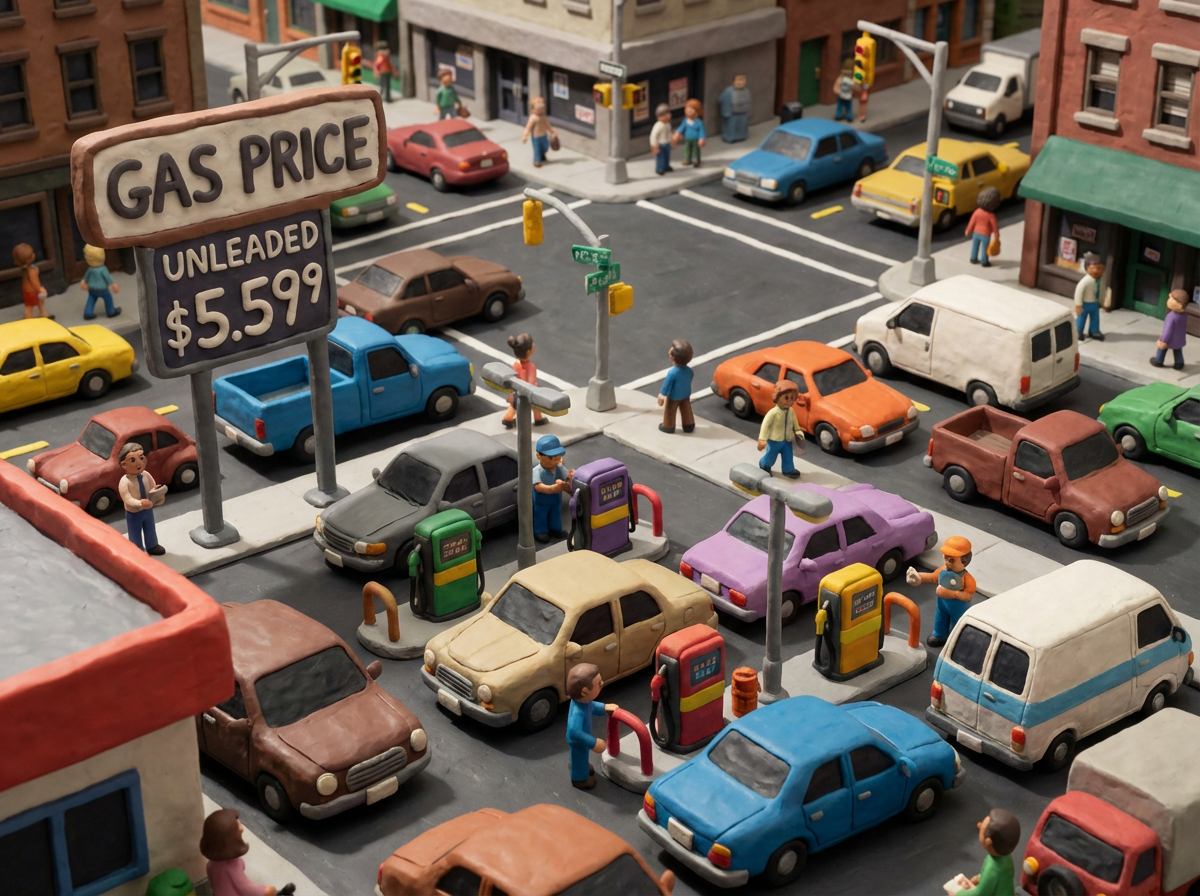
I grew up watching my stepfather hunt for cheap gas like it was a blood sport.
He would literally drive 20 miles out of his way — burning well over a gallon in the process — to save a nickel a gallon on a 15-gallon fill-up. The math on that is brutal: he was spending more in fuel to save roughly 75 cents. By any rational measure, he was losing money and time. But that's not how it felt to him. Spotting the cheapest price on the placard, pulling in, and winning — that was the point. The price sign had done its job on him completely.
I've thought about that a lot over my years in product management, because it turns out that gas station pricing is one of the most sophisticated (and mostly accidental) exercises in behavioral economics running continuously in the American marketplace. There's more to learn from a pump handle than from most MBA curricula.
Let me break it down.
The Nine-Tenths: A Tax Artifact That Became a Psychological Monument
Here's a trivia question for your next dinner party: why does gas always end in nine-tenths of a cent?
The honest answer is that it started as a tax accounting convenience. When states began imposing gasoline taxes in 1919, a gallon of gas cost about 10 cents. Rather than round a fractional tax up to a full penny — which would have felt like a massive price hike at the time — stations passed the exact fraction straight to the pump price. The federal government codified this with the Revenue Act of 1932, which imposed a 1-cent-per-gallon tax during the Great Depression to fund road infrastructure. That tax was supposed to expire in 1934. It did not.
What started as bookkeeping became marketing. By the 1950s, with the interstate highway system expanding and gas prices displayed on roadside signs for the first time at scale, stations rounded up to the 9/10 pricing as a way of "squeezing the buck as far as they can" — and because a price ending in .9 looks lower than a rounded number, even when the difference is meaningless.
We're talking about one-tenth of a cent. You can't pay in fractions of a cent. Your credit card rounds the total. And yet, across the entire US fuel retail industry, those fractional pennies add up to roughly half a billion dollars per year. One station owner who experimented with dropping the nine-tenths figured he lost about $23 a day. He went back to it.
This is what a pricing convention looks like once it's fully locked in. Nobody mandates the nine-tenths anymore. But as Patrick De Haan at GasBuddy puts it: "Now every station engages in it, so if a station were to suddenly stop, they're gonna look more expensive and people aren't gonna fill up there as often."
That's a prisoner's dilemma baked into your price tag. The convention is a structural moat — and nobody built it on purpose.
PM takeaway: Pricing conventions, once established, become competitive traps. Every participant knows the convention is arbitrary. No individual actor can rationally break from it. Think carefully before you set a pricing norm — you may be living with it for ninety years.
Reference Pricing and the Anchor on Every Corner
The nine-tenths is only half the story. The other half is why gas pricing works so powerfully on consumer psychology in the first place.
Reference pricing — the behavioral economics phenomenon where a "known" price becomes the baseline against which consumers judge all future prices — works on gas like almost no other product in the market. Here's why: almost everything about how gasoline is sold conspires to make the reference price sticky.
The price is displayed publicly, in large digits, at eye level, from a moving vehicle, at multiple locations along every commute. You see it without trying. And unlike a laptop or a couch — purchases you make rarely, with prices easily forgotten — most people are filling up at least once a week. The anchor isn't set once. It's refreshed constantly, passively, whether you're thinking about it or not.
This is what made my stepfather tick. He wasn't being irrational by his own internal model — he had a very precise sense of what gas should cost, updated almost daily, and any deviation from that price was viscerally felt. The gas station placard had colonized his reference frame completely.
This also explains why gas prices carry outsized political weight far beyond their actual share of most household budgets. The price of a gallon of gas is one of the few numbers that a majority of American adults know, off the top of their head, at any given moment. When it spikes, it feels like an attack. When it falls, it feels like relief. The emotional salience is wildly disproportionate to the dollars involved — and that's entirely a product of the reference pricing mechanism.
Replacement Cost Pricing: Why the Gas in the Ground Doesn't Matter
Here's the pricing mechanic that most people don't think about, but that explains a lot of the behavior at the pump.
Gas stations don't price based on what they paid for the fuel currently sitting in their underground tanks. They price based on what it will cost to refill those tanks at the next delivery. This is called replacement cost pricing, and it's entirely rational: if you sell a gallon at yesterday's wholesale price but tomorrow's delivery costs more, you've permanently eroded your margin. Every gallon sold is effectively a futures position on the next order.
The implication is that price increases transmit almost instantaneously. The moment wholesale prices rise, retailers update the placard — because every gallon sold below replacement cost is a real loss. The tank on hand is irrelevant. What matters is what the next tank will cost.
Price decreases, on the other hand, are under no such urgency. If the underground tank is full of fuel bought at last week's higher price, there's no financial pressure to drop the retail price until that inventory is sold through. And even then, competitive dynamics may not force it quickly.
Which brings us to the phenomenon that has a formal name in economics.
Rockets and Feathers: Asymmetry Has a Name
What you've probably noticed at the pump — prices shoot up overnight when crude spikes, then take weeks to drift back down — is not just an impression. It's a well-documented market phenomenon that economists call asymmetric price transmission, or more colorfully, "rockets and feathers."
One study found that gas prices fall twice as slowly as they rise after a major change in oil prices. If it takes four weeks for prices to climb 25 cents, it takes eight weeks for them to fall 25 cents once crude settles back down.
The intuitive explanation — that gas companies are just pocketing margin on the way down — turns out to be more complicated than that. The explanation with the most empirical support is that consumers search for lower-cost gas more intensely when prices are rising than when they are falling. When prices spike, people hunt. They compare, they divert, they drive past their usual station to check the one two blocks over. When prices fall, people feel relieved and go back on autopilot.
That asymmetry in consumer behavior creates an asymmetry in competitive pressure — which is what drives the asymmetry in how quickly prices move.
Research from Kellogg frames this through Kahneman's "Thinking Fast and Slow" lens: when prices are stable or falling, consumers run on System 1 (habit, autopilot). When prices spike, they shift to System 2 (deliberate search, comparison). Retailers face intense competitive pressure during the rocket phase, less so during the feather phase. The pricing follows the attention.
My stepfather, bless him, ran on System 2 all the time. He never habituated. He was always hunting. Which meant he was also always being manipulated by the very price signs he was hunting, but that's a story for another day.
What This Means for Product Managers
Gas pricing didn't get designed this way. It accreted over a century of tax law, accounting practice, competitive mimicry, and behavioral quirk. But the lessons are real, and they transfer.
Anchors exist whether you set them or not. In gas markets, the reference price is set by the competitive environment — hundreds of placards refreshed daily. In your product, the anchor might be a competitor's price, a previous version's pricing, or what the customer paid last quarter. The question isn't whether an anchor exists. It's whether you're shaping it or being shaped by it.
Pricing conventions become structural. The nine-tenths cent is a prisoner's dilemma at scale: everyone knows it's arbitrary, nobody can break from it. Before you establish a pricing norm — a discount structure, a packaging tier, a price-ending convention — think about whether you're comfortable being locked into it.
Consumer attention is asymmetric, and that's a lever. The rockets-and-feathers mechanism isn't unique to commodities. The underlying dynamic — that customers search harder when prices rise than when they fall — applies broadly. Price increases generate scrutiny. Price cuts generate goodwill that fades faster than you'd expect. That asymmetry has real implications for how and when you move on price.
Price to replacement, not to cost of goods. If you're in a market where your input costs are volatile, pricing to what you paid (rather than what you'll pay next) is a recipe for margin erosion. Gas stations figured this out by necessity. Most software companies are still getting it wrong when they think about pricing for AI-driven products with volatile inference costs.
The pump is a weird place to go looking for pricing wisdom. But the psychology working on my stepfather — the anchor, the hunt, the reference price burned into his mind by years of roadside signage — is the same psychology working on your customers. It's worth understanding.
Even if you're not willing to drive 20 miles to save a dollar.
If this resonated, I'd love to hear how you think about reference pricing in your own products. Hit reply.