The Loop is the Moat
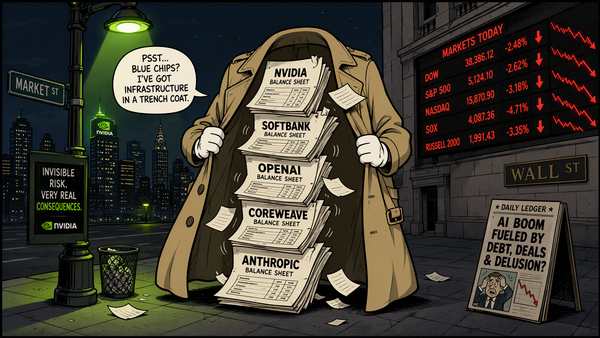
Nvidia's CEO just resigned, Anthropic is about to go public with $26 billion of its own vendors' money inside the deal, and OpenAI is circling the airport under a mountain of SoftBank debt. Different stories. Same shape.


On Tuesday, Anthropic launched the roadshow for what may be the largest IPO in market history. Eight hundred twenty-five million shares, $70 to $78 a piece, pricing expected next Wednesday, debut Thursday under the ticker ANT.
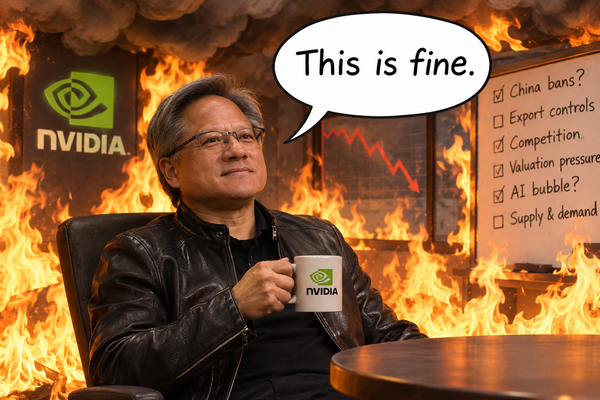
On Wednesday, Jensen Huang resigned as CEO of Nvidia. Colette Kress is holding the interim tag while the board figures out what it actually knew and when.
And somewhere in between, the Commerce Department was still explaining why a Singaporean shell company — one that grew its balance sheet a hundredfold in a year, whose principal the intelligence community now believes was running an MSS operation, whose chips the Treasury Secretary says four separate departments voted to blacklist — is still not on the Entity List. Commerce has the pen. Nobody else does.
Three stories. One week. If you're looking for the thread that ties them together, it's not artificial intelligence.
It's the loop.
You've seen this movie, you just worked at a different studio
For those of us who were in the industry in 1999, the shape is familiar enough to make your molars ache. Telecom vendor financing: Lucent lends its customers the money to buy Lucent switches. Nortel does the same. Cisco books revenue from customers whose ability to pay depends entirely on Cisco's willingness to keep lending. Everyone's numbers go up. The equipment is real, the revenue is real, the cash is... well, some of it is real, and the rest is a loan from the vendor wearing a mustache.
When it unwound in 2001 and 2002, hundreds of billions in market value evaporated, and analysts who had spent two years praising the "accelerated revenue recognition" spent the next two years asking how they'd missed that the buyers and the bankers were the same people.
We did miss it. We missed it because the loop feels like validation from the inside. Every node vouches for every other node. The metric prints. Discovery is a formality when your champion at the customer is also your investor.
I bring this up not because history repeats, but because it rhymes on a schedule.
Read the Anthropic S-1 aloud and you can hear the circle
Buried in the amended filing, past the growth numbers that genuinely are staggering — $16.96 billion in Q3 revenue, up from $11.56 billion the quarter before, with growth decelerating from 144% to 47% sequential — is a detail that deserves more air than it's gotten.
Seven companies agreed to buy $26 billion of Class N stock in a private placement at the IPO price, closing immediately after the offering. The list reads like a bill of materials for a data center: AMD, Broadcom, Google, Micron, Microsoft, Nvidia, TSMC.
Anthropic's compute suppliers. Buying a private stake in their own customer, at the IPO price, hours before the public gets its shot.
Now stack the commitments the other direction. Per the S-1, Anthropic plans to spend at least $110 billion with Amazon through 2036, $120 billion with SpaceX through 2029, $115 billion with Google and $45 billion with Microsoft through 2033. Amazon and Google are Anthropic's largest customers. They're also its owners. The filing itself flags the two largest customers as roughly a quarter of 2025 revenue.
So walk into this restaurant. The landlord is your best customer. The food supplier is your investor. The banker holds a private share class you can't buy. The menu is printed by the guy you're paying $115 billion.
Is it a business, or is it a set?
To be fair to Anthropic — and I want to be fair, because the operating numbers are real and the enterprise traction is real — this is not fraud, and nothing in the S-1 is hidden. It's all disclosed, in the dry language of risk factors. Circularity is not a crime. As Noah Smith has argued, some of it is simply what heavy-industry financing looks like. Boeing finances airlines. GE financed power plants. The vendors take equity in customers they believe in and the arrangement persists because the underlying demand is real.
Maybe. The honest version of the question is not "is this a loop?" It is: where does the loop touch ground truth?
In 1999, the answer was nowhere. The loop touched other loops. When it met the actual demand for actual bandwidth at actual prices, it collapsed.
There's one more thing in that S-1 that should make a product person sit up. Anthropic's public shareholders — the ones buying Class A at $70 to $78 — get one vote per share. A single Class T share, held by the Long-Term Benefit Trust, elects a majority of the board. A single Class F share, held by the founders' LLC, carries 50.1% of the voting power. You're not buying ownership of the loop. You're buying a ticket to ride it.
"We're delighted to welcome the public markets as partners in our mission."
"Wonderful. What do we own?"
"A claim on future claims."
OpenAI is circling the airport while SoftBank mortgages the house
Meanwhile, the company that started all of this — the one whose product announcement in November 2022 detonated the entire capital cycle we're now living inside — declared its own IPO "ill-advised" this year and pushed to 2027 at the earliest. Sam Altman said the quiet part with unusual candor: the timing is wrong, the governance is a headache, and public shareholders would complicate decisions "not obviously in the interest of our business."
He's not wrong. He's also describing a company that needs the public markets' capital and can't yet afford their questions.
So the loop above the loop kicks in. SoftBank, whose cumulative bet on OpenAI now sits around $64.6 billion for roughly 13% — money largely raised, because of course it is, by taking the largest dollar-denominated loan in its own history, up to $40 billion, and blowing through its self-imposed 25% loan-to-value ceiling to do it — keeps writing checks its balance sheet has to cosign. S&P cut SoftBank's outlook to negative. The Stargate expansion in Texas fell through over financing. And in one of the great quiet ironies of this entire cycle, Masayoshi Son sold SoftBank's entire Nvidia position for $3.3 billion to fund all of this. Those shares would be worth well over $150 billion today. He traded the machine for the output of the machine.
OpenAI, for its part, has been living the punchline in real time. In September it went out looking to raise $30 billion or more at a $1.4 trillion valuation. In late October, in the middle of an AI-stock selloff and what the Journal called "tepid" interest, it cut the ask to $20 billion and the mark to $1.25 trillion. The first money hit the wire on November 6: eleven billion dollars, against a $20 billion target that was itself already the compromise. By mid-month, reports had the total creeping toward $15 billion — still a third short, in a round priced by its own backers, one of whom is also its infrastructure landlord, one of whose chips it must keep buying forever. And Nvidia, whose $99 billion of customer equity positions and $42.4 billion in equity purchases over six months make it less a chip company than a merchant bank with fabs, is guaranteeing OpenAI's rent at the SB Energy site — up to $105 billion of it.
The same week OpenAI's round was shrinking, buyers of Anthropic's IPO shares were reportedly eyeing a valuation closer to $1.1 trillion than the $2 trillion that had been discussed a month earlier. The loop, in other words, is starting to ask the public market for an outside opinion. That is what the loop is for.
Let that sit. The chipmaker lends the lab money. The lab pays the chipmaker's tenant the rent the chipmaker guarantees. Everyone records revenue. The circle, as Jensen Huang put it in his defense of the practice, is "not circular because we put a little bit of money in, and a lot of money comes back."
That is a description of a circle. He has simply declared the entry point virtuous, and used the loop's own momentum as the proof.
Product Bistro doesn't run on ad spend or an algorithm surfacing it in anyone's feed. It runs on PMs passing it to other PMs. If this issue was useful, forward it to someone on your team, or subscribe so the next one lands directly in your inbox.
And then there's the loop nobody priced in
Which brings us back to Wednesday, and to the strangest loop of all — the one that runs through the Commerce Department.
The short version, for anyone who has been sensibly offline: a small Singapore gaming company called Megaspeed became, almost overnight, the funnel for something like a fifth of Nvidia's revenue. Its balance sheet grew from $33 million to $3 billion in a year, funded by refundable deposits traced to entities connected to Alibaba. Jensen Huang personally vouched for it: no China shareholders, nothing to see. Singapore revenue hit 22% of Nvidia's total in mid-2025 and then, in the very next earnings report, Singapore — one of only five disclosed markets — simply vanished from the geographic breakdown, via a methodology change the company had previously argued against.
And when Commerce investigators finally got around to the case, Nvidia's general counsel phoned the export-control chief to ask whether his agency was behind a Singapore detention — then cited that chief's name to the investigating agents to get access. The agents got spooked enough to route the whole thing to the DOJ, where it has sat, reportedly motionless, ever since. Commerce hasn't added a single company to the Entity List in over a year. Treasury, Defense, State, and USTR all backed blacklisting Megaspeed. Nobody else had the pen.
I keep returning to the Commerce Secretary's disclosed stake in all this: his old firm held about $1.2 billion in Nvidia stock before he joined the administration, and Huang described him as "the person I talk to most." The regulators didn't take the money. They took the friendship. The checkpoint didn't fail because it was bought. It failed because it was absorbed — captured by proximity, walled off from its own case, deferring upward to a man deferring, in effect, to the investigated.
If the Anthropic loop is vendor financing, the Megaspeed loop is vendor financing with better tailoring.
The PM's job in an economy of loops
So what do we do with this? We're not Senators. We can't subpoena Tim Teter. Most of us won't be allocating to the Anthropic IPO.
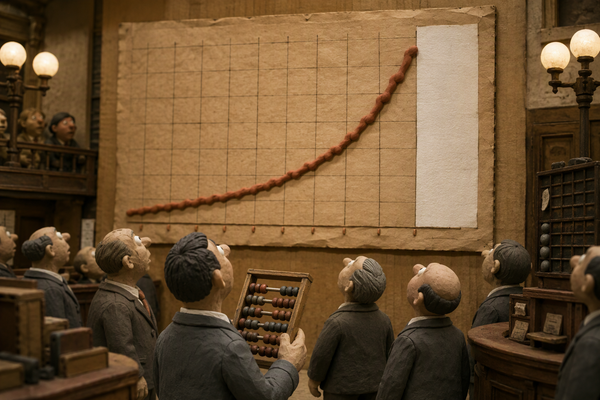
But most of us do run metrics, and most of us have, at some point, stood in front of a chart that kept going up and felt the room relax. So here is the discipline, and it is not complicated:
Every metric that prints inside a loop needs a checkpoint that lives outside it. Not a dashboard — a checkpoint. Someone whose incentives are not the number. Something that touches the ground.
In product work we have a name for the failure mode: you built the metric, then the org optimized for the metric, then the metric stopped meaning anything, and for two quarters nobody noticed because the chart was green. This is that, at planetary scale, with GPUs.
When a number keeps printing — revenue growth, agent eval scores, "no evidence of diversion" — the question is never "is the number true?" The number is always true. The question is: who is the customer of this number, and did they pay for it with money that came from inside the circle?
The Anthropic S-1 answers that question in its risk factors, if you read them slowly. The Nvidia customer list answered it when Singapore disappeared. The Commerce Department answered it in August of last year, when the agents on the case were told to route everything through one office and stop naming the company in their own files. In every case, the answer was already there. The loop's real product is the feeling that you don't need to ask.
The reckoning
Next Thursday, if the calendar holds, a company that lost $104 billion in nine months — mostly on paper, mostly fair-value marks on its own financing obligations, but still — will list at a valuation that prices in another decade of compounding that almost nobody outside the loop can independently verify, in a deal where its own suppliers took a private cut of the action hours before you were invited in.
I am not saying don't buy it. I'm saying know what you're buying, which is a ticket on a carousel, and carousels only run while the music plays.
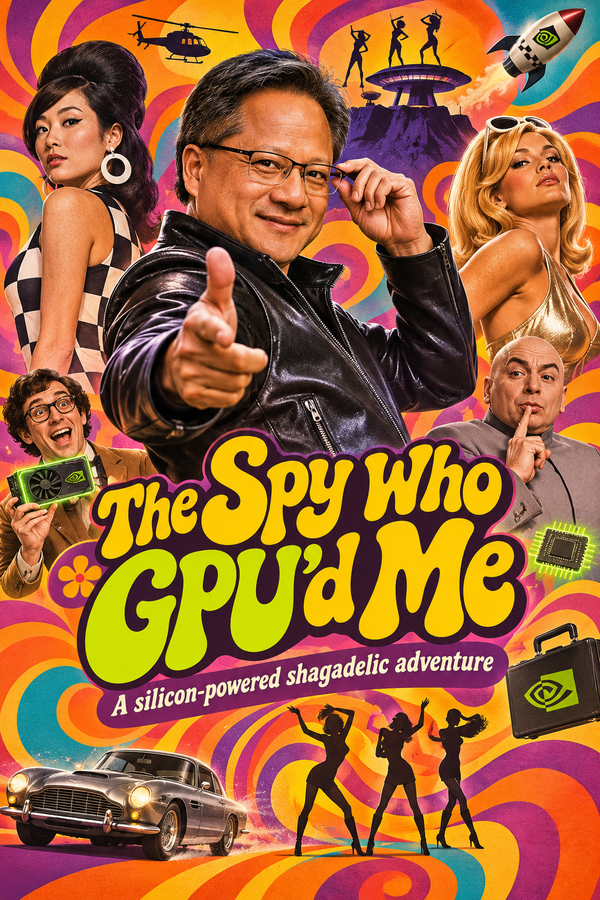
And the music, for what it's worth, was written in 1968:
Round like a circle in a spiral, like a wheel within a wheel
Never ending or beginning on an ever-spinning reel
Like a snowball down a mountain, or a carnival balloon
Like a carousel that's turning, running rings around the moon
Michel Legrand wrote the melody, the Bergmans wrote the words, and Noel Harrison sang it over the opening credits of a film about a charming financier who treats the system as a game and wins over the investigator assigned to catch him. It seemed like an odd reference when it first came to mind this week. It doesn't anymore.
The uncomfortable question for those of us who build and measure things for a living: when the loop is this well-constructed — when the customers own the vendors, the vendors bank the labs, the labs charm the regulators, and the regulators hold the only pen that could break the circle — what exactly is our job?
Maybe it's this: be the person who asks, at the roadmap review, at the board meeting, at the pricing call, the one question the loop is designed to make feel rude.
Who's paying for this number?
The Product Bistro publishes weekly-ish. If this one gave you something to chew on, forward it to the colleague who always asks the rude questions — they're doing the job.