The Banker Left the Building
Nvidia stopped being a chip company years ago. It became the bank of the AI buildout — supplier, customer, investor and financier to its own customers. On Thursday, the banker resigned. What happens to the $20B web of GPU-backed loans now?

Thursday happened fast. Jensen Huang resigned as CEO, president and board member of Nvidia, effective immediately. The CFO, Colette Kress, took over as interim chief executive while keeping her day job, which is what a company does when it has no succession plan and no time. The board created its first-ever chairman in the company's 33-year history. And by the afternoon, the President of the United States was on Truth Social nominating Tim Cook for a job Cook hasn't said he wants.
The least interesting question of the week is who ultimately gets that job. The interesting question is what happens to the bank.
The company that was also a clearing house
Strip the designer leather jacket off the story and Nvidia stopped being a normal chip company years ago. CNBC described it this week as "supplier, customer, investor, financier, and partner" to scores of AI companies, and that's not a compliment, it's an org chart. Consider what sits on and around its balance sheet:
More than $20 billion of loans across the industry collateralized by Nvidia GPUs, where the collateral depreciates every quarter. Lease backstops and vendor financing for customers who couldn't otherwise afford the chips. Equity stakes in many of the same companies placing the orders. And the interest math that gives the game away: CoreWeave, the flagship of the neocloud fleet, is guiding to interest expense of roughly three times its operating income. The GPU pays for itself in about two and a half years of gross cash, but the chip is effectively obsolete in three or four, which leaves about a year of surplus that also has to service the debt.
The polite term for this architecture is "reciprocal financing." Product people have seen the small version: a platform company extends store credit to its own app developers, then books their purchases as revenue growth and calls it ecosystem momentum. It works beautifully until someone asks what the demand would look like without the credit.
And at the center of it all was one dealmaker. The sovereign AI partnerships, the neocloud rescues, the circular mega-deals with OpenAI and friends — those were Huang's handshake plus Nvidia's balance sheet. He was, in effect, the clearing agent for the AI buildout. He resigned Thursday.
Product Bistro doesn't run on ad spend or an algorithm surfacing it in anyone's feed. It runs on PMs passing it to other PMs. If this issue was useful, forward it to someone on your team, or subscribe so the next one lands directly in your inbox.
The risk officer is minding the till
So what changes under Kress? Start with incentives, because incentives are what interim leadership is made of.
An interim CFO who keeps both titles is telling you the board wants continuity of the numbers, not boldness of the strategy. Her job is to get through Tuesday's earnings call without a second crisis. Nobody in that seat expands a reciprocal financing program. Nobody in that seat signs a new lease backstop for a wobbly neocloud. The natural moves are the conservative ones: guide low, freeze the deal flow, and — the classic interim maneuver — sweep anything questionable into one ugly transition quarter that the permanent CEO gets to disown later.
That's why the November 17 call matters more than any earnings call Nvidia has ever given, and not for the revenue number. Watch the language. If Kress says anything about "customer verification," "end-use review," or related-party disclosure, the Megaspeed question — how much of the celebrated demand was real, and how much was sanctioned-market arbitrage with a Singapore address — stops being a journalism question and becomes an accounting event. Bernstein's Stacy Rasgon has already said he can't advocate buying in size until the allegations stop arriving. The whole market is pricing the drip, not the quarter.
The deeper shift is slower and bigger. The financing web doesn't collapse without Huang; it hardens. Handshake terms become contract terms. Contract terms get repriced by committees instead of negotiated on tarmacs. The weakest neoclouds, the ones already down 40 percent this fall with Gartner predicting 80 percent of the category gone by 2030, are about to discover that their cost of capital went up this week even though no central bank did anything.
The outer loop
Now zoom out one more ring, because Nvidia is not the most leveraged believer in this story. That would be SoftBank.
Masayoshi Son has put $64.6 billion into OpenAI for a 13 percent stake, borrowing at coupons as high as 9.75 percent to finish the last tranche. His loan-to-value ratio has climbed through 20 percent and is heading for the 25 percent ceiling he set for himself, with his own CFO conceding the breach and S&P cutting his outlook to negative. He's the anchor equity in Stargate, with financial responsibility for the venture, after its flagship Texas expansion was quietly canceled and his $50 billion Switch acquisition died in January.
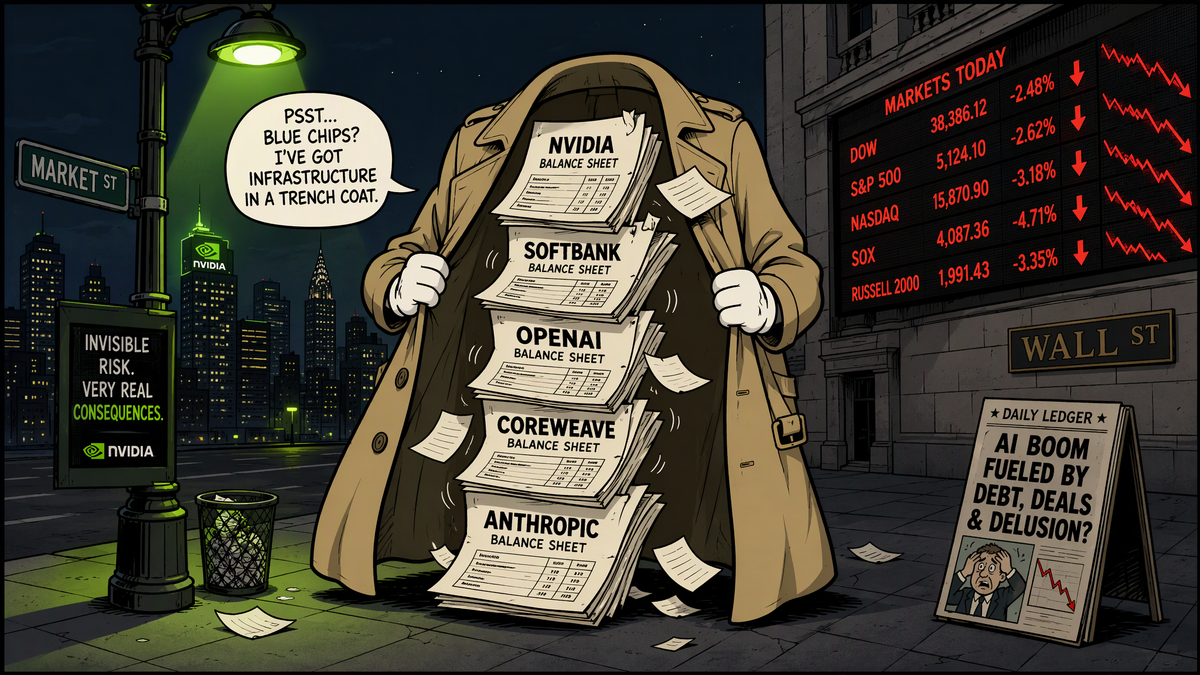
Trace the chain and you can see why it matters: SoftBank's net asset value is marked against OpenAI's $852 billion valuation. OpenAI's compute commitments anchor the neocloud backlogs. The backlogs collateralize the GPU loans. The loans fund Nvidia's orders. It's one structure, wearing five different balance sheets as a trench coat.
The valve
Which brings us to next Thursday, and the thing the entire web is quietly depending on: Anthropic prices its IPO.
Not because Anthropic needs the money — it has $131.7 billion in cash and its operating cash flow is positive. It needs the window, since OpenAI slipped to 2027 and this is the only frontier-lab offering on the calendar. But everyone else needs the print. A completed IPO at $1.2 or $1.3 trillion, even down from the $2 trillion whisper number of October, validates the private marks that OpenAI, and therefore SoftBank's balance sheet, and therefore the whole financing web, are priced against. A pulled IPO — the kind of rumor floating around this week — is the scenario where those marks get questioned all at once, and where "reciprocal financing" gets renamed by journalists using a less polite word that starts with C.
The company at the center of the AI economy just spent a week proving that its most important product was never the GPU. It was trust: in one man's judgment, in one company's willingness to underwrite its own customers, in the private valuations that make the arithmetic work. GPUs scale. Trust doesn't.
Tim Cook hasn't answered. Kress hasn't guided. Anthropic hasn't priced.
to be continued