The Affair was Small. The Architecture Wasn't.
Since Sunday, $600 billion of Nvidia's value has burned. Not on chip demand or earnings — on a hotel video and a classified memo. The affair was the pin. The concentration of trust in one man's judgment was the bubble.

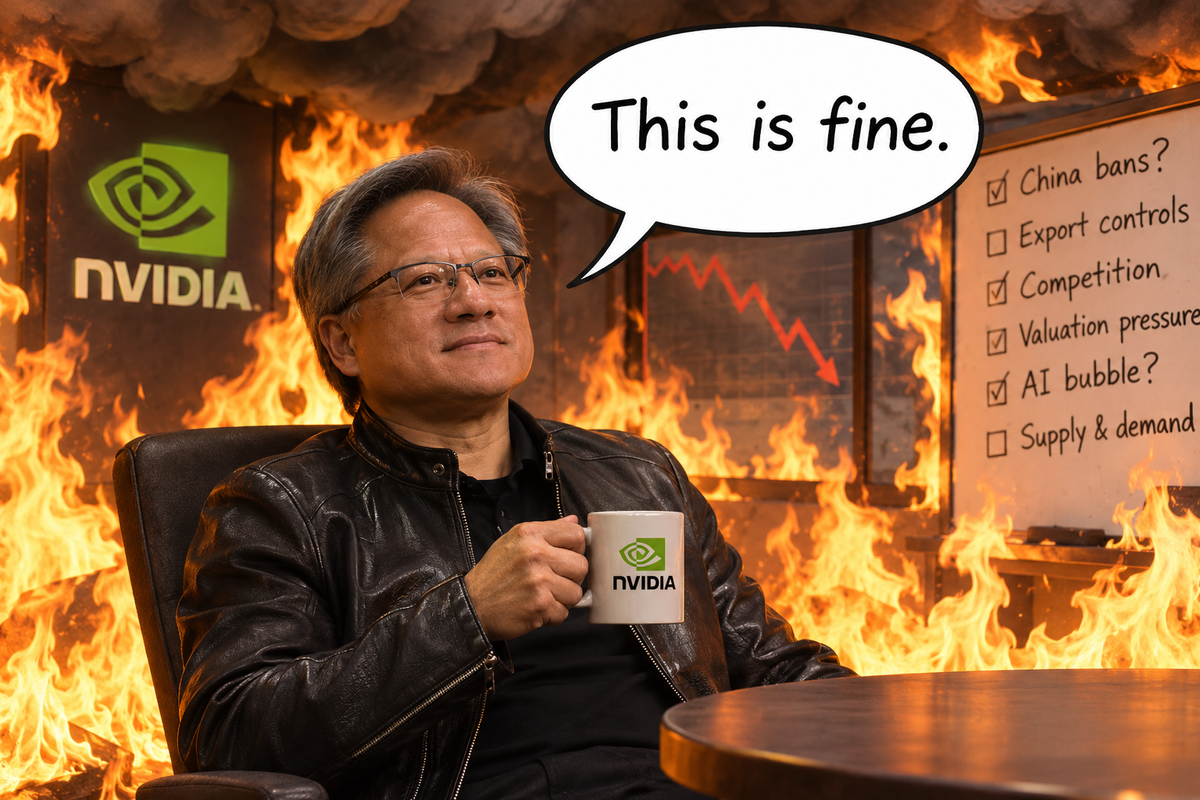
Let's start with the number, because the number is the story. Since Sunday, roughly $600 billion of Nvidia's market value has been destroyed. From the October 6 peak, the drawdown is around $1.7 trillion. Congress takes months of hearings and floor fights to appropriate $600 billion when the economy is on fire. The market incinerated that much paper wealth in four days, on the strength of a hotel video and a classified memo.
Sit with that for a second.
What was actually destroyed
An honest caveat first, because it makes the real point sharper. Market cap is not stimulus. When Congress spends $600 billion, paychecks clear and bridges get built. When Nvidia loses $600 billion, no factory closes and no payroll bounces. What changed is the collective belief about what Nvidia's future profits are worth. The real-economy damage travels through narrower pipes: the index funds inside 70 million retirement accounts, the debt collateral of neocloud companies already down 30 to 45 percent this month, Anthropic's IPO price, which is being set this week while all of this is on the front page.
But if the $600 billion was paper, then what exactly burned? Trust. Specifically, trust in one person's judgment, which the market had priced as if it were a durable asset, like fabs or CUDA. It wasn't. It was a candle.
The pin and the bubble
Here is the argument I keep coming back to. Affairs are common. Six-hundred-billion-dollar reactions to affairs are not. What made this one systemic is that Nvidia was built so that Jensen Huang's personal credibility was load-bearing. Around 60 direct reports. No COO. No board chair. No succession plan. A founder who texts small customers himself and whose children work down the hall. For three decades that structure was praised as genius, because it compounded. This week we found out what it does on the way down.
So no, an affair did not destroy $600 billion. An affair revealed that someone had architected a $4 trillion company, and by extension a visible chunk of the AI economy and the American stock market, such that an affair could. The sex was the pin. The concentration of trust was the bubble. Blaming the pin is a way of not talking about who inflated the balloon, which was, if we're honest, all of us: boards, investors, analysts, presidents.
Where there's two
On Wednesday the New York Times reported a second affair, this one with a direct report, Nvidia's healthcare VP, sourced to five employees. By that night the Wall Street Journal reported the board is preparing to remove him. Polymarket puts the odds he's gone by year-end at 88 percent.
Two things about this deserve your attention. First, where there are two there are usually more, and this script has run before. McDonald's fired Steve Easterbrook in 2019 over one consensual relationship, then found others, and then the SEC charged him for misleading investors about the circumstances. Remember that Huang's first characterization of his dealings with Alice Huang, before Sunday's confession, was "ordinary business." There's already a shareholder lawsuit parked on exactly that sentence.
Second, and I want to hold both of these at once: the behavior can be real, and someone can still have chosen this week to surface it. The leaks arrived sequenced. The memo, then the Air Force One briefing, then the second affair, each one landing on a market-sensitive day. That is a campaign with a calendar. It doesn't exonerate anybody. But if you're trying to understand this story rather than just gawk at it, the timing is evidence too.
As for the psychology, the honest version is boring. Power doesn't necessarily make men worse. It removes friction, and twenty years without friction degrades anyone's risk perception. Nobody told him no. Eventually you stop hearing the question.
What happens next
As I write this, the board has met and announced nothing. Earnings are Monday. Some directors reportedly want the CFO, Colette Kress, as interim. Whoever gets the job inherits a company with 60 direct reports shaped around one man, a federal counterintelligence probe, a subpoena threat, and a lawsuit. Nvidia can absolutely keep building chips without Jensen Huang. The open question is whether anyone else can make the industry's next bet stick, because that authority was never in the org chart. It was in him.
That question, who takes over and whether the job is even possible, is a whole post by itself.
to be continued