The Founder Is Not the Product
The petition to bring Jensen Huang back assumes Nvidia can't function without him. That isn't an argument for reinstatement. It's an admission of failure — and a design review every product leader should run on their own organization.


On Thursday, November 12, Nvidia announced that Jensen Huang had resigned as president, CEO, and board member. Effective immediately. After 33 years.
The press release gave no reason. The market supplied several: the stock fell more than 4% that day and kept sliding, closing a brutal week down roughly 13%.
Then the weekend happened. A petition appeared — "Stand with Jensen" — demanding that Nvidia's board reinstate Huang while an independent investigation establishes the facts. Elon Musk signed it. So did Tim Sweeney, Garry Tan, and Amjad Masad, along with a roster of prominent investors. Within days it passed 100,000 signatures, thousands of them self-identified Nvidia employees. The Financial Times reported that Huang himself has discussed a comeback with allies.
And here's the sentence that should stop every product manager mid-scroll. Musk, explaining why Huang matters:
"Jensen drove supply chain brilliantly at Nvidia, but many of those deals were a handshake with Jensen, not a written contract. Without Jensen, at least some of those critical deals will be lost."
Read that again. The CEO of Tesla just said, in public, that some of the most important commercial arrangements at one of the most valuable companies on Earth rest on one man's handshake. Not the company's handshake. Not its contracts, its systems, its institutional memory. His.
That isn't a tribute. It's a dependency disclosure.
For the record, and because this distinction matters: Huang's resignation followed reports about his personal relationships — including one involving a business executive whom some U.S. intelligence officials suspect of links to Chinese intelligence (an allegation that remains unverified, and that Beijing has denied), and another involving a Nvidia executive who reported to him. Nvidia's independent directors had engaged Wachtell, Lipton to investigate. CFO Colette Kress is interim CEO. Treasury Secretary Scott Bessent has publicly opposed Huang's return. Congress wants answers. All of this is allegations and process so far, not established findings, and the personal conduct is context for this essay, not its subject.
The subject is what the panic revealed. Because the petition's premise — a company of this size, value, and strategic importance might not be able to function without its founder — is being treated as an argument for bringing him back.
I'd like to treat it as a design review.
If your product organization can't function without its founder, you haven't built an institution. You've built a dependency.
Founder Dependency Debt
We already have a name for this condition in engineering. Call this one founder dependency debt: organizational reliance on one individual's judgment, authority, relationships, and institutional knowledge.
In an early-stage company, concentrating those capabilities in a founder isn't just rational — it's often necessary. The founder resolves ambiguity fast, holds the product vision in one head, and keeps the whole thing coherent while the org chart still fits on a napkin.
The problem is that the debt doesn't amortize. It compounds.
You can see it accumulating in the tells: strategic decisions that keep escalating to the founder. Product teams optimizing for what the founder will like rather than what customers need. Senior executives who've quietly stopped challenging strategic assumptions. Roadmaps that run through one person's intuition. Succession plans that exist on paper and have never survived contact with a Tuesday.
And the nasty property of founder dependency debt — like a lot of technical debt — is that success hides it. The stronger the company performs, the less pressure there is to repay anything. Nobody refactors the decision-making architecture during a golden quarter. The bill arrives all at once, usually on the worst possible day.
Huang's 33-year run at Nvidia was extraordinary by any measure. But here's the uncomfortable formulation: if the durability of the business depends on the durability of the man, how much of an institution was ever built?
The Indispensable Engineer
Every product manager has lived the small-scale version of this. A team has a brilliant principal engineer — the one who knows why every cursed decision was made, who can unstick in an hour what has blocked the team for a week. Management celebrates this person as indispensable.
A good PM hears that word as an alarm, not an accolade.
Because the failure mode was never really the engineer leaving. It's the slow, quiet moment when everyone else stops trying to know what she knows. Why document the rationale when you can ask her? Why develop another architect when the escalation path is one desk away? The team doesn't become dependent in a day. It drifts into dependency, one reasonable shortcut at a time.
The fix is unglamorous and well understood: distribute knowledge, grow other decision-makers, write down the why, make the architecture legible to people who weren't in the room. None of that diminishes the brilliant engineer. It protects her contribution from becoming a single point of failure.
One caveat, because analogies should illuminate rather than flatter: replacing a CEO is not like replacing an engineer. The analogy shows the mechanism — how dependency accrues, and why success accelerates it. It doesn't pretend the org chart is symmetrical. A founder who is also the public face, the chief strategist, and the keeper of a decade of handshake deals carries a load no principal engineer does.
Which is exactly why the debt question matters more, not less, at the top.
Vision Is Not a Capability
None of this is an argument that Jensen Huang was overrated. He wasn't. The bet on accelerated computing, built and defended long before the market agreed it existed, and the CUDA ecosystem grown around it — that's one of the great long-horizon platform strategies the industry has ever seen. Saying anything else would be contrarian cosplay.
But it's worth separating two things that Silicon Valley routinely blends into one heroic blur:
Strategic vision — recognizing the opportunity early, committing resources against consensus, building the ecosystem, holding the line for a decade.
Institutional capability — creating an organization that can keep executing, adapting, and making sound strategic decisions without the visionary's constant presence.
A great product organization needs both. And we tend to grade founders almost entirely on the first while treating the second as someone else's problem — some future CFO's, some succession committee's, someday.
Here's the question I'd put on the wall: if a founder's primary accomplishment is building an extraordinary business, shouldn't the durability of that business be part of how we judge the accomplishment?
Dependence and effectiveness are not the same thing. A company can be magnificent and fragile at once. In fact, the more magnificent, the easier it is to miss the fragility — right up until the market does the math out loud, in public, over a weekend.
Product Bistro doesn't run on ad spend or an algorithm surfacing it in anyone's feed. It runs on PMs passing it to other PMs. If this issue was useful, forward it to someone on your team, or subscribe so the next one lands directly in your inbox.
The Ability to Say No
My day-job bias is showing here, so let me state it plainly: I've spent years managing products subject to ITAR and EAR export controls, inside the broader maze of international compliance obligations. That experience teaches you something that looks boring until the day it isn't.
Sophisticated exporters do not encounter export compliance as a surprise.
It's not a pop quiz the legal department flunks one quarter. It's a product-management responsibility baked into the operating model: it shapes product architecture, configuration, market eligibility, customer qualification, sales channels, contracting, and distribution. Companies that operate in regulated markets build processes, controls, and documentation for exactly this. They build the muscle before they need it.
Nvidia has been an international technology company for decades, and advanced-chip export restrictions have been a headline business issue for years. I have no idea what the Wachtell investigation will find, and this essay isn't a finding — investigators establish facts, not columnists.
But the structural question stands regardless of the findings: when an opportunity is enormous, commercially irresistible, and personally championed by a dominant leader — what in the organization's design can say no, independently, and survive saying it?
An organization's ability to say no to a profitable opportunity may be as important a measure of product maturity as its ability to identify a profitable market.
That's the part of this story that has nothing to do with affairs or espionage allegations. A company organized around one person's judgment has to answer a hard design question: does the capability to challenge that judgment exist as an institution, or only as his willingness to be challenged?
Apple Already Ran This Experiment
We've seen a version of this movie before. In 2011, Steve Jobs died, and the obituaries for Apple were written almost before the flowers arrived. Indispensable founder, irreplaceable taste, done.
Tim Cook then did something the obituaries didn't consider: he ran a functioning organization. Apple grew to multiples of its 2011 size under a man whose keynote charisma was, to put it kindly, different. Whatever you think changed about Apple's product soul in the Cook era — and plenty changed — the company demonstrably retained enormous value from the founder's work after the founder was gone.
The detail that matters for our purposes: Cook inherited a working organization, and he'd already helped build its operational spine. Jobs's great product visions were still paying rent for years — but so was the machine that could ship, price, and supply them at scale.
Apple doesn't prove every founder is replaceable. It proves something more useful: that a company can be more than its founder's container.
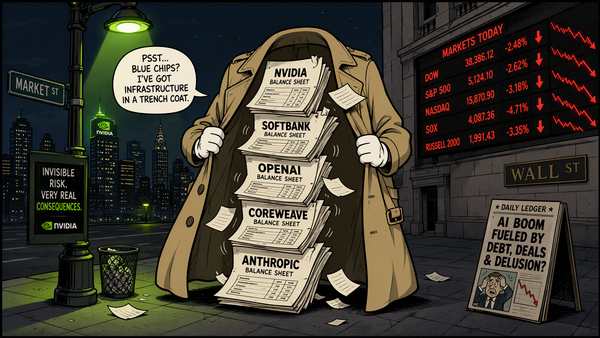
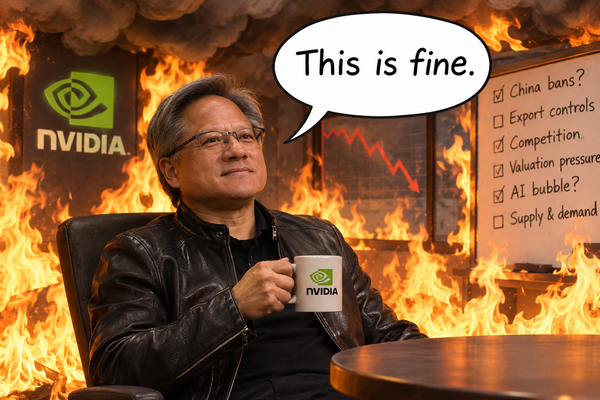
Which brings us to the test Nvidia now faces, whether it wanted it or not. The stock ticker is a lousy instrument for measuring it — the whole AI economy is wobbling over capex, debt, pricing, and returns on invested capital, and Nvidia could stumble with Huang in the chair while the petition counts its signatures. Don't grade the succession on a share price.
Better questions: Can the company keep executing its roadmap? Does the technical talent stay? Can leadership make consequential strategic calls without escalating them to a founder who no longer works there? Can compliance and governance operate independently of commercial pressure? Do customers and partners stay confident — not in a person, but in the institution?
Those are capability questions. And capability is what the next year will actually test.
Build the Kitchen, Not the Chef
I spent my early working life in restaurant kitchens, so forgive the metaphor, but this one is load-bearing.
Every town has the great chef-owner — the one with the sauce that exists nowhere but in his head. The regulars swear by it. The reviews say you can't get this anywhere else. And they're right, in the worst possible way: the day that chef doesn't show up, there is no restaurant. There's a person with tables.
The chefs who build something that lasts do the opposite of what the mythology celebrates. They write the recipe down. They make the line cooks taste everything. They build a kitchen that plates the dish beautifully on their night off — because the point was never to be missed. The point was the food.
We spend an enormous amount of industry energy celebrating leaders who make themselves indispensable. The keynote heroics, the founder-whisperer profiles, the "only he can" mythology — we treat it as evidence of greatness.
Maybe it's evidence of an unfinished build.
Nvidia's next chapter will tell us a great deal about what Jensen Huang actually built. If the company thrives without him, it won't diminish his legacy — it will complete it, the way Apple completed Jobs's. And if it can't function without him, then we have to ask whether thirty-three years of extraordinary success concealed an equally extraordinary dependency.
So here's the uncomfortable question, and it's not really about Nvidia:
If the name on the door left your company tomorrow — the founder, the VP, the architect, the one person whose calendar everyone orbits — what exactly keeps working?
And the follow-up nobody wants in a performance review: what are you doing this quarter to make the answer survivable?