The Craft of Product Management
My near three decades in the product management trenches has reinforced that product management isn't a recipe, it is a craft, and it is a craft honed by repetition and practice.


There is no single book that makes you a product manager. There is no certification exam, no bootcamp cohort, no framework you can memorize that fully prepares you for what the role actually demands. If you've spent any time around the profession, you probably already know this, even if you can't always articulate why.
Product management is a craft. And like any craft, it rewards the people who are willing to develop it the slow, hard way, through repetition, failure, earned judgment, and a constant willingness to adapt to what the moment requires.
The ones who treat it as a job title, a checklist, a ladder rung, tend to flame out. The ones who treat it as a living practice tend to last. That distinction is the whole ballgame.
What Stays Constant
Across nearly three decades in this role, spanning industries and technologies, one thing has never changed:
"The core job of a product manager is to find the overlap between what is technically possible, what customers actually need, and what a business can sustain. That's it. That's always been it."
Everything else, the frameworks, the tools, the methodologies, the org structures, those are just the clothing the role wears in a particular era. Underneath, the skeleton is the same. You are the person responsible for making sure the organization is building the right thing, for the right reasons, in a way that actually has a market behind it.
That may sound deceptively simple. I can assure you it is not. "The right thing" requires deep customer understanding, not just survey data, but the kind of ground-level intuition you develop by sitting in customer environments and watching how people actually work. "The right reasons" requires a clear-eyed grasp of the business model, the competitive landscape, and what leadership is trying to achieve. "A market behind it" requires a certain cold honesty about whether real people will actually pay for what you're building, or whether you're just shipping something because it was interesting to build.
Holding all three of those in tension, simultaneously, without letting one dominate the others, is the craft. When it's done well, it looks effortless. It almost never is.
What Has Changed
What has shifted, dramatically, over those same decades, is the environment in which that craft gets practiced.
When I started, product management in tech was largely practiced in B2B industrial settings where product cycles were measured in years, customer relationships were long and deep, and the path from customer conversation to shipped product was slow enough that you had time to think. Mistakes were expensive, but they were also recoverable. The feedback loop was long.
Then came the consumer internet era. Then SaaS. Then mobile. Then the constant, churning acceleration of cloud and software-defined everything. The feedback loop compressed from years to quarters to weeks. The expectation that a product manager could fully own a long-range roadmap and execute against it in a stable environment quietly became a relic. Agility became the religion of the industry, for better and worse.
More recently, AI has added another layer of complexity. Not because it changes what product management fundamentally is, but because it expands both the possibility space and the noise. There are more things you could build. More data to interpret. More stakeholder opinions informed by hype rather than customer evidence. Navigating that requires, again, the same core skills, just applied with more discipline than ever.
The companies changed, too. Early in my career, a product manager often had clear domain ownership, a defined market, a relatively predictable customer base. As companies scaled, product management fractured into specialties: growth PM, platform PM, data PM, technical PM, go-to-market PM. The role became less monolithic, more modular. What it means to be a "good product manager" now depends enormously on where in the organization you sit and what kind of company you're at.
None of this changed the underlying craft. It just made it harder to fake it.
The Adaptation Imperative
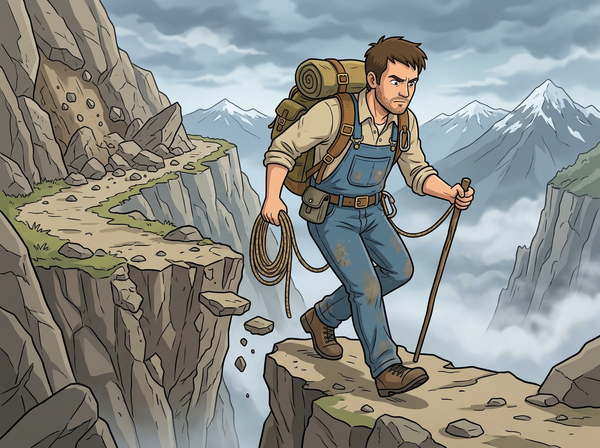
Here's the part that doesn't get enough air-time: the product managers who survive a long career are not the ones who mastered one version of the role. They're the ones who were willing to become a different version of themselves as the terrain shifted.
I've watched smart, capable people stall out because they got very good at a specific context and couldn't let go of it when the context changed. The PM who was brilliant in a hardware-dominated product environment, and then struggled when software ate their industry. The PM who thrived in a startup where they could make fast, solo calls, and then couldn't function in an enterprise where alignment and stakeholder management were the actual job. The PM who built a career on instinct and customer intuition, and then hit a wall when data fluency became table stakes.
Adaptation is not optional. It's not a nice-to-have. It's the survival mechanism.
"The product managers who last are the ones who stay genuinely curious about what the role demands right now, not what it demanded the last place they worked."
That curiosity has to be real, not performed. It's the difference between someone who reads the industry press to keep up appearances and someone who actually wrestles with what they don't know yet. I've been in enough new domains across my career to understand that the beginner's mind is not a liability. It's a significant asset, if you're not too proud to use it.
The Invisible Work
There's a reason craft metaphors resonate with the product management conversation. A craftsperson isn't just skilled. They're trained in a way that becomes embodied, internalized, visible in how they approach a problem before they've even named the problem.
For a product manager, that invisible work looks like pattern recognition. Knowing, without being able to fully explain why, that a customer's stated request is masking a different underlying need. Sensing when a roadmap discussion has shifted from strategy into politics. Recognizing when the business case for a feature is solid versus when someone is rationalizing work they already decided to do.
That pattern recognition doesn't come from a certification. It comes from repetitions, from being in enough rooms where the stakes were real and the feedback was unambiguous. From being wrong in ways that cost something. From watching someone more experienced handle a situation and understanding, afterward, what they saw that you didn't.
It also comes from domain depth. One of the aspects of a long product management career that doesn't get enough credit is how much your accumulated domain knowledge, even across very different industries, teaches you about markets. Customers in semiconductor capital equipment and customers in enterprise networking are not the same. But the dynamics of a customer who has a mission-critical dependency on your product? That's the same everywhere. The pressure a sales team feels at the end of a fiscal quarter? That's the same everywhere. Learning to read those dynamics is transferable in ways that formal training rarely prepares you for.
The Honest Truth
Product management is not for everyone. The ambiguity is real. The accountability without authority is real. The fact that you own the outcome but control almost none of the inputs, that's real, and it grinds people down.
But for the people who lean into it, who develop the craft instead of just performing the role, it's one of the more interesting ways to spend a career. You are, at the center of your job, trying to solve hard problems for real people in ways that generate sustainable business outcomes. That's not nothing.
The role will keep changing. The tools will evolve, the company structures will shift, the methodologies will cycle through their fashions. What won't change is the need for someone in the room who understands the business, can talk to customers with genuine curiosity, and has the judgment to make hard calls with incomplete information.
That's the craft. It's been the craft the whole time.
The rest is just figuring out, over and over again, what the current moment requires of you, and whether you're willing to deliver it.
If this tickled something in you, why not share it with a colleague or to your socials audience?